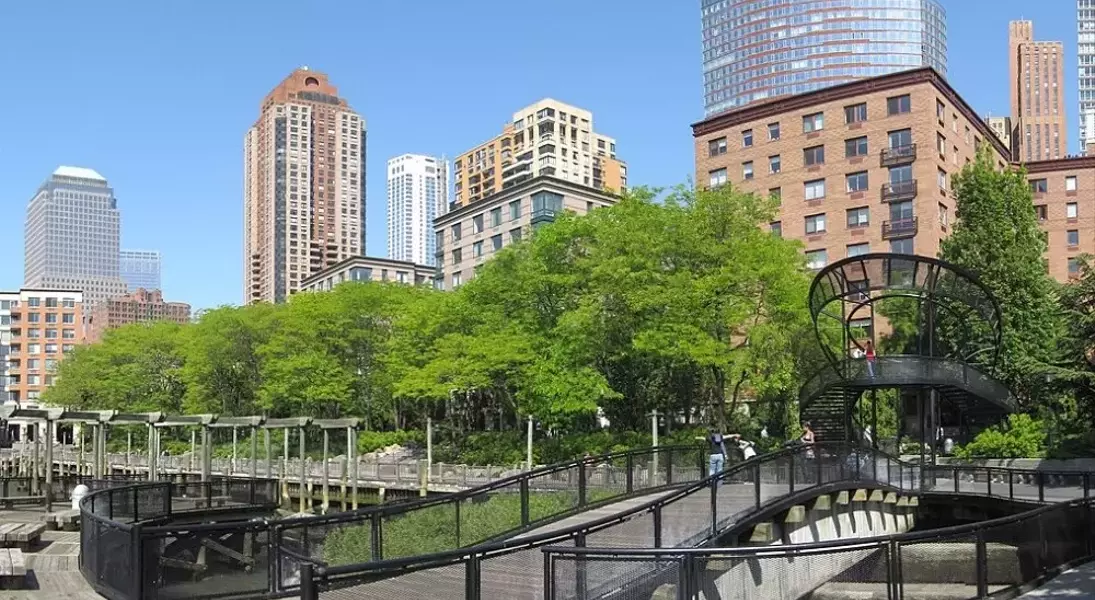
A prominent 40-year-old public art piece in Battery Park City is being dismantled to make way for a controversial resilience project. The sculpture, titled "Upper Room" by Ned Smyth, a 20-column court featuring an elongated table with inlaid chessboards, was Battery Park City's first public art commission in 1986. Its removal is part of the North/West Battery Park City Resiliency (NWBPCR) project, designed to install a coastal flood barrier system and protect the area from natural disasters, such as the damage caused by Hurricane Sandy. This decision has met with significant opposition from the artist and local community members, who question the necessity of demolishing an established artwork for the flood prevention scheme.
The "Upper Room" sculpture, completed in 1986, has long been a notable feature of Battery Park City, providing a unique public space with its design reminiscent of ancient architecture. Last year, the Battery Park City Authority (BPCA) even produced a video highlighting the artist and the sculpture's importance within New York's cultural landscape. However, despite its historical and artistic value, demolition began recently as part of the broader NWBPCR initiative. The project's primary goal is to establish a robust coastal defense along the Hudson River waterfront, spanning from First Place to Chambers Street, in response to the extensive damage, estimated at $310 million, inflicted by Hurricane Sandy.
The resiliency project extends beyond the sculpture's removal, also necessitating the closure of the North Cove Marina, one of the city's most expensive harbors, for five years. This temporary closure has sparked varied reactions among local sailors and businesses. Ned Smyth, the artist, whose work was previously valued at $1.5 million by the BPCA, along with numerous residents, has voiced strong objections to the demolition. John Dellaportas, Vice President of The Battery Alliance, criticized the decision as "preposterous," arguing that the area beneath the sculpture has never experienced significant flooding and therefore, its removal for flood prevention is unwarranted.
The site where "Upper Room" currently stands is intended to become a tidal gate as part of the new infrastructure. This sculpture is reportedly the only commissioned public artwork slated for demolition under the NWBPCR project. While Smyth was informed of the impending demolition two years ago and explored the possibility of relocating the piece, the BPCA cited the sculpture's deterioration and the logistical difficulties of moving it as reasons for its destruction. A spokesperson for the BPCA stated that the removal is crucial for flood mitigation to safeguard lives and property, acknowledging the sculpture's integral role in Battery Park City's history and its foundational contribution to the area's extensive public art collection.
In addition to the sculpture, hundreds of trees are also planned for removal, further illustrating the scale of the construction. This scenario of sacrificing existing structures for new development is not isolated to New York; San Francisco recently saw the dismantling of the brutalist Vaillancourt Fountain as part of its Embarcadero Plaza renovation, signaling a recurring theme in urban redevelopment where public art and historical elements are sometimes superseded by infrastructure projects.
The ongoing Battery Park City Resiliency project, while aimed at bolstering environmental protection against future climate challenges, has ignited a debate concerning the preservation of public art and the balance between urban development and cultural heritage. The decision to demolish Ned Smyth's "Upper Room" underscores the complex choices facing city planners when implementing large-scale infrastructure improvements. This situation highlights the tension between practical necessity and artistic legacy, prompting questions about alternative solutions and the true cost of progress in urban environments.