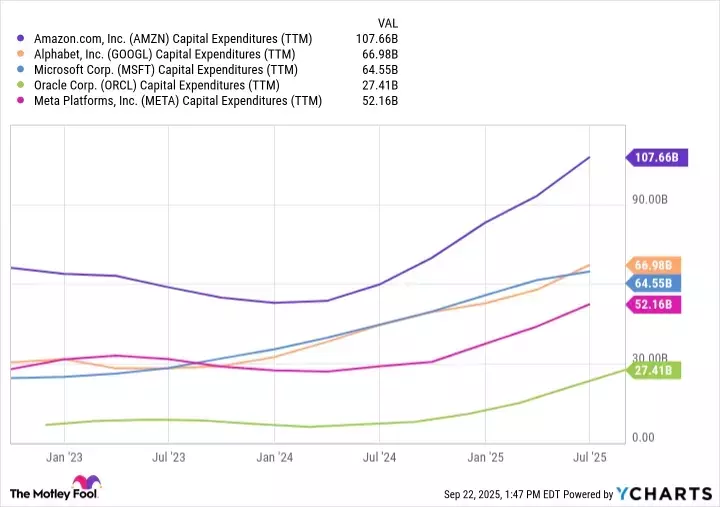

This article explores the current high valuations in the artificial intelligence (AI) market, addressing investor concerns about a potential bubble by comparing it to the dot-com era. It highlights a McKinsey & Company report projecting a massive $7 trillion investment in data center expansion, predominantly for AI, over the next five years, suggesting that AI's growth is driven by substantial infrastructure development and widespread enterprise adoption rather than mere speculation.
The AI Era: A New Paradigm, Not a Repeat Bubble
AI Valuations and Echoes of the Past
The burgeoning artificial intelligence sector has propelled major indices like the S&P 500 and Nasdaq Composite to unprecedented heights. This surge is largely attributable to a select group of technology companies. Firms such as Nvidia, Broadcom, and Taiwan Semiconductor Manufacturing have joined the ranks of trillion-dollar enterprises, while established tech giants like Microsoft, Alphabet, Amazon, and Tesla have experienced renewed investor interest. However, these elevated valuations have prompted some investors to question whether the AI market is heading towards a speculative bubble, reminiscent of the late 1990s internet boom.
Data Center Expansion: The Foundation of AI's Future
A recent analysis by McKinsey & Company provides a different perspective on these market dynamics. The report forecasts a near-tripling of global data center capacity by 2030, increasing from 82 gigawatts to 219 gigawatts. A significant portion, approximately 70%, of this expansion is expected to be driven by the demands of AI workloads, with the remaining capacity dedicated to traditional cloud and IT applications. This monumental infrastructure build-out is projected to involve capital expenditures totaling approximately $7 trillion over the next five years, underscoring a tangible and substantial investment in the underlying technology.
Distinguishing AI Growth from Past Market Speculation
The current landscape of AI investment differs fundamentally from the dot-com bubble. During that period, many internet companies boasted high price-to-sales multiples, often lacking significant revenue or facing persistent cash burn, with valuations largely based on metrics like user engagement rather than concrete profitability. In contrast, AI technologies have already achieved broad adoption across diverse industries, from cybersecurity and pharmaceutical research to autonomous vehicles, retail, and robotics. This widespread integration suggests a more robust and essential role for AI in the global economy. Furthermore, the continuous financial flows into data center infrastructure, as highlighted by McKinsey, indicate a sustained revenue generation potential for companies facilitating this technological transformation.
Long-Term Upside: The $7 Trillion Investment Perspective
Unlike historical bubbles fueled by fleeting optimism, the current growth in AI is underpinned by continuous investment in essential components such as chips, servers, networking hardware, and energy-efficient systems. This extensive infrastructure development is paving the way for the next generation of products and services, with tangible financial growth benchmarks. The anticipated $7 trillion investment is not a sign of an impending bubble, but rather the initial phase of a profound infrastructural supercycle poised to redefine entire economic sectors. For investors, this signifies that while market fluctuations are inevitable, the fundamental demand for AI is firmly established. Companies specializing in semiconductor design and manufacturing, cloud hyperscale services, and innovative energy solutions are particularly well-positioned to benefit from these powerful, long-term trends. Consequently, investments in leading AI stocks are seen as strategic opportunities within this ongoing AI infrastructure revolution.
