
Alphabet, the parent company of Google, has recently ascended to the highly exclusive $3 trillion valuation club, a testament to its formidable position in the technology sector and its aggressive embrace of artificial intelligence. This milestone was reached following a substantial boost in its stock price, largely attributed to a favorable legal outcome. The company's strategic integration of AI across its diverse portfolio, particularly within Google Search and Google Cloud, is driving impressive revenue growth and solidifying its market leadership. Despite this significant valuation increase, Alphabet's stock maintains a competitive edge, presenting a compelling investment opportunity compared to its industry peers.
The American corporate landscape has a rich history of fostering global leaders in market valuation. This journey began with U.S. Steel, which first achieved a $1 billion valuation in 1901. General Motors followed suit in 1955, reaching $10 billion amidst the booming automotive industry. By 1995, General Electric marked another significant milestone as the first company to hit $100 billion. However, it was Apple that truly broke new ground in 2018, crossing the $1 trillion mark propelled by the immense success of products like the iPhone.
Currently, nine U.S. companies boast valuations exceeding $1 trillion. Among these, an even more select group of four has graduated to the elite $3 trillion tier: Apple, Microsoft, Nvidia, and the newest entrant, Alphabet. Alphabet's inclusion in this exclusive club on September 15th underscores the profound impact of its diverse operations, which encompass Google, YouTube, and Waymo, all increasingly powered by advanced artificial intelligence technologies.
Alphabet's stock is presently hovering near an all-time high. Yet, its valuation metrics suggest that there could be substantial room for further appreciation. Analysts project Alphabet's total revenue to reach a staggering $394 billion in 2025, with Google Search expected to contribute more than half of this figure, cementing its status as the company's primary revenue driver. The strategic deployment of AI has transformed potential challenges into significant tailwinds for the tech giant.
Initially, there were concerns that the emergence of AI chatbots like ChatGPT could divert internet traffic away from Google Search. In response, Alphabet proactively developed its own suite of large language models, Gemini, and an eponymous chatbot, directly competing with innovative start-ups. These Gemini models now power AI Overviews, a new Google Search feature that integrates text, images, and external links to provide users with more comprehensive and immediate answers. Positioned above traditional search results, AI Overviews have been adopted by over 2 billion users monthly and generate advertising revenue at a rate comparable to standard Google Search outputs, effectively safeguarding the company's core business. This success is reflected in Google Search's accelerated revenue growth, which climbed from 9.8% in Q1 2025 to 11.7% in Q2 2025, indicating strong positive momentum.
While Google Search remains Alphabet's largest enterprise, Google Cloud stands out as its fastest-growing segment. In the second quarter alone, Google Cloud reported a record $13.6 billion in revenue, marking a 32% year-over-year increase, an acceleration from the 28% growth observed in the first quarter. This division provides cutting-edge data center infrastructure, equipped with chips from leading suppliers such as Nvidia, allowing developers to build and deploy AI software. Furthermore, it offers access to a vast array of pre-built large language models, including Gemini, enabling over 85,000 organizations to rapidly advance their AI development. The future growth of Google Cloud appears robust, evidenced by a $106 billion order backlog at the close of the second quarter, representing a 38% annual increase and signaling that demand for its services is outstripping supply.
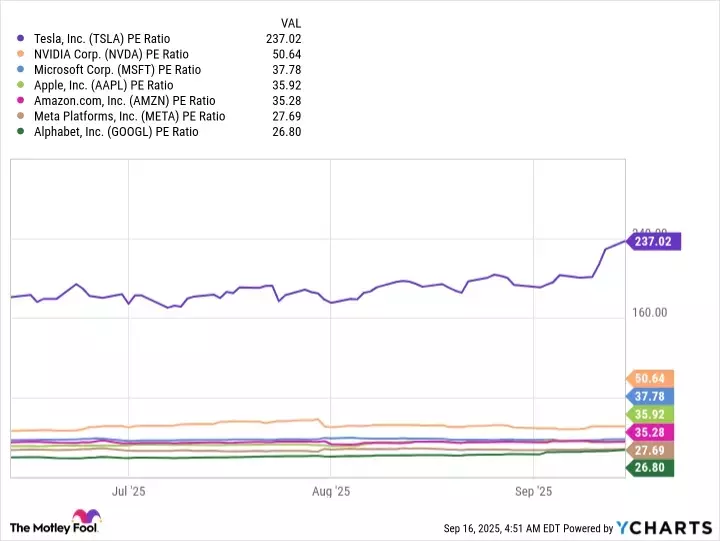
For some time, Alphabet's valuation had been constrained by a lawsuit filed by the U.S. Department of Justice, which alleged monopolistic practices in the internet search market. The suit specifically highlighted Alphabet's substantial payments to partners like Apple to maintain Google as the default search engine on devices such as the iPhone, thus limiting competition. Investors had prepared for potentially severe repercussions, including a forced breakup of the company. However, a recent lenient judicial decision ruled against a breakup and permitted Alphabet to continue these partnerships, provided they are not exclusive. This outcome spurred a nearly 20% surge in Alphabet's stock, propelling it into the $3 trillion valuation territory. Despite this impressive gain, Alphabet's price-to-earnings ratio of 26.8 makes it the most attractively valued stock among the 'Magnificent Seven' tech giants, suggesting ample potential for continued growth for investors.
