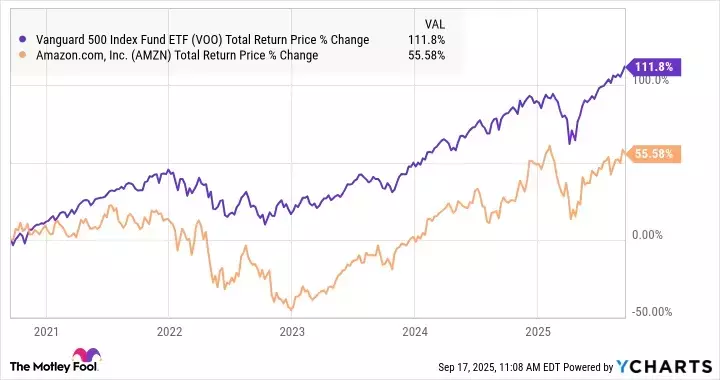

Amazon, a global corporate behemoth, has shown a notable divergence in its stock performance compared to the broader market index over the last half-decade. While the S&P 500 demonstrated robust growth, nearly doubling investors' initial capital, Amazon's returns were considerably more modest. This article delves into the potential factors contributing to this trend, offering a nuanced perspective on the company's market trajectory and its current investment appeal, especially in a period where overall market valuations are at elevated levels.
A closer examination of Amazon's stock trajectory reveals that its recent performance, while lagging the S&P 500, needs to be contextualized within the unique market conditions of the past few years. The extraordinary surge in e-commerce activity during the COVID-19 pandemic significantly boosted Amazon's valuation in the initial part of this five-year window. This exceptional growth phase set a very high baseline, making subsequent comparisons appear less favorable. Despite these dynamics, Amazon's enduring market position and its strategic diversification into various sectors continue to present a compelling case for investors seeking long-term value, even as the market experiences unprecedented highs.
Amazon's Recent Stock Performance and Market Context
Amazon's stock has demonstrated a gain of around 56% over the last five years, which is significantly less than the 112% total return achieved by the S&P 500 during the same period. This underperformance can largely be attributed to the unique market conditions prevailing five years ago, specifically the surge in e-commerce demand during the COVID-19 pandemic. At that time, Amazon's stock had already experienced substantial growth, starting from an elevated position that made subsequent comparative gains appear smaller.
Despite trailing the S&P 500 in recent years, a broader perspective dating back to the beginning of 2020 reveals that Amazon has actually outpaced the index by approximately 26 percentage points. This indicates that the company's growth prior to the five-year measurement period was exceptionally strong, influencing the perceived underperformance. The post-pandemic normalization of e-commerce volumes further contributed to this shift, as consumer behavior gradually returned to pre-pandemic patterns. Consequently, while Amazon's short-term stock performance may seem underwhelming, its long-term trajectory and foundational strength remain notable, suggesting it could still represent a valuable addition to an investment portfolio even with current market highs.
The Investment Outlook for Amazon
Amazon's current stock valuation, despite its relative underperformance against the S&P 500 over the last five years, positions it as an appealing prospect for investors. The company's significant market capitalization of $2.5 trillion underscores its dominant presence and extensive operational scale. Its P/E ratio stands at 35.33, reflecting market confidence in its earnings potential. Furthermore, Amazon maintains a gross margin of 49.61%, indicating strong profitability from its core operations. These financial metrics, combined with its continued innovation and expansion into new sectors, suggest a robust foundation for future growth.
Looking ahead, Amazon's diverse business model, encompassing e-commerce, cloud computing through AWS, digital advertising, and logistics, provides multiple avenues for revenue generation and market leadership. The temporary dip in e-commerce growth post-pandemic does not diminish the long-term prospects of digital retail and the company's foundational role in this space. With a focus on strategic investments and customer-centric innovation, Amazon is well-positioned to capitalize on evolving market trends and reinforce its status as a significant global player. This makes it an attractive investment, particularly for those seeking growth opportunities in a fluctuating economic landscape.
