
Aptiv, a significant entity in the automotive components sector, is embarking on a strategic restructuring plan, intending to divide its operations into two distinct businesses. This initiative aims to unlock greater value for shareholders by separating its slower-growth electrical distribution systems from its high-potential safety and software division. This move mirrors past strategic shifts by the company, which has a history rooted in General Motors, demonstrating a recurring theme of divesting segments to concentrate on areas with enhanced growth prospects and market appeal.
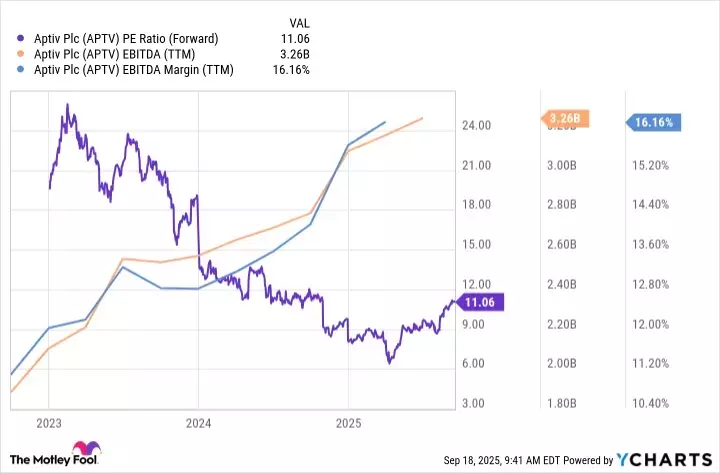
Tracing its origins back to Delphi Automotive, a former General Motors subsidiary, the company underwent its first major spin-off in 2017. At that time, Delphi retained traditional powertrain technologies, while Aptiv was established to focus on emerging, high-growth areas like vehicle electrification and safety systems. This initial separation was met with considerable market enthusiasm, driven by the burgeoning interest in electric vehicles (EVs), which temporarily boosted Aptiv's valuation. However, as the EV hype moderated, Aptiv's stock metrics, particularly its price-to-earnings ratio, began to align more closely with conventional auto-parts suppliers, despite consistent improvements in its earnings and profit margins.
The perceived entanglement with the broader automotive industry's cyclical nature became a limiting factor for Aptiv's valuation. To address this, the company has announced a second significant split. The new structure will feature one entity dedicated to electrical distribution systems (EDS), characterized by steadier growth, and another concentrating on the dynamic safety and software segments. The latter possesses considerable potential to diversify revenue streams beyond the traditional automotive market.
This current spin-off is slated for completion in the first quarter of 2026. Proponents believe this separation will empower both new companies to optimize capital allocation tailored to their specific growth profiles. Crucially, the faster-growing safety and software business is expected to command a premium valuation, shedding the constraints often imposed on traditional auto-parts suppliers. For context, in 2024, the EDS segment reported $8.3 billion in sales with a 9.5% EBITDA margin, while the safety and software division generated $12.2 billion in sales with a significantly higher 18.8% EBITDA margin. The strategic advantage of the safety and software business lies in its capacity for expansion into non-automotive sectors, thereby decoupling its valuation from the automotive industry's inherent volatility.
Ultimately, this strategic unbundling is poised to re-rate Aptiv's market perception and valuation. The prior acquisition of Wind River, a communications software provider, in 2022 signaled Aptiv's proactive steps toward expanding beyond its traditional automotive confines. For astute investors, acquiring shares at its currently subdued price-to-earnings ratio could prove to be a judicious move. Should the company successfully execute this spin-off, continue its diversification efforts, and sustain robust EBITDA margins, the coming years are likely to witness a considerable appreciation in its market valuation, delivering substantial returns to its stakeholders.
