
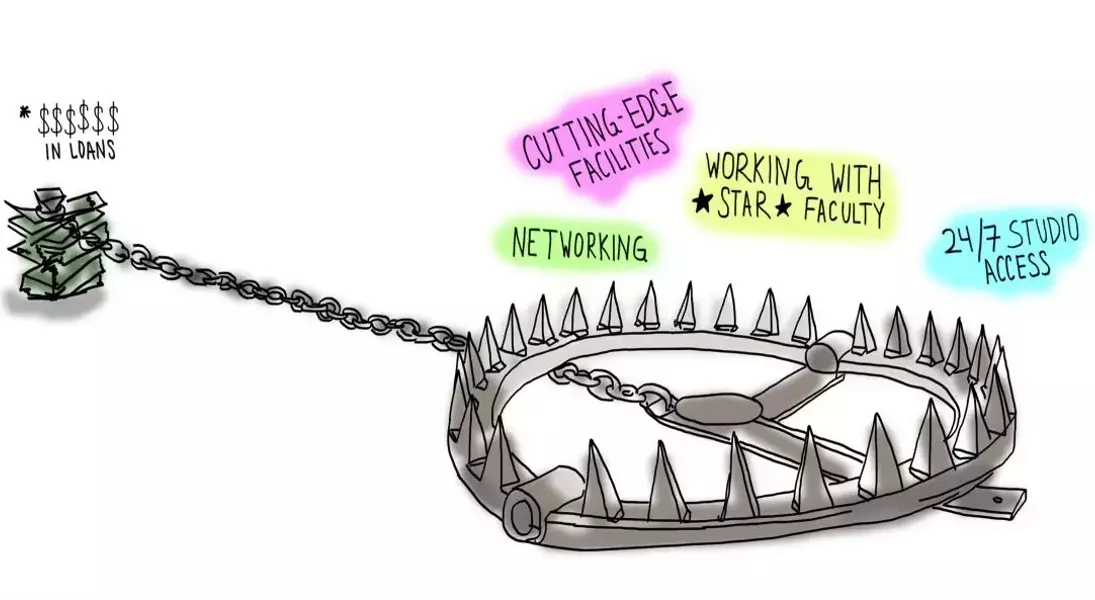

Art schools often present themselves as direct pathways to artistic success, yet the reality for many graduates involves substantial debt and uncertain career outcomes. This discourse examines the underlying mechanisms of this 'debt trap,' tracing its origins to the rise of the MFA degree and shifts in higher education funding. While institutions capitalize on perceived prestige and access to renowned faculty, the practical skills necessary for a sustainable artistic career are frequently overlooked. This systemic issue disproportionately affects marginalized students, transforming education into a commodity rather than a public good. However, historical examples and contemporary alternative models offer promising avenues for fostering creative talent without the burden of overwhelming financial obligations.
Dissecting the Financial Burden of Art Education and Exploring Viable Alternatives
In a revealing analysis, the prevalent model of art education, particularly the Master of Fine Arts (MFA) degree, faces scrutiny for its escalating costs and often questionable returns on investment. The narrative begins with a striking analogy from the early 2000s reality show Making the Band, where aspirants undertook demeaning tasks to gain access, mirroring the sacrifices and self-doubt many art students endure. Despite assurances of access to star faculty, cutting-edge facilities, and pathways to gallery representation or teaching positions, many graduates find themselves burdened with significant student loans, lacking the practical business acumen to navigate the competitive art world.
Historically, the MFA's evolution in the mid-20th century transformed art practice into a professionalized academic pursuit. Concurrently, a fundamental shift occurred in higher education financing, moving from a public good to an individual investment. Notably, changes under governors like Ronald Reagan in California, and later as U.S. President, led to reduced federal aid and the conversion of grants into loans, effectively privatizing the cost of education. This confluence created an environment where prestige became a marketable commodity, sustained by student debt.
A critical observation highlights the disparity between the theoretical emphasis in art school curricula and the practical skills essential for artists' survival, such as grant writing, archiving, and self-advocacy. This gap leaves many unprepared for the economic realities of an artistic career. The issue is exacerbated for Black, Indigenous, and first-generation students, who, despite being championed for diversity, often graduate with disproportionately higher debt and fewer opportunities. This practice, it's argued, allows institutions to extract cultural capital while failing to provide equitable support.
However, the article does not dismiss the inherent value of art education entirely, acknowledging the formation of lasting friendships, spaces for experimentation, and transformative critiques. It posits that the true challenge lies in decoupling artistic learning from a system of exclusion and debt. Inspiring precedents, such as the interdisciplinary Black Mountain College (active from the 1930s to the 1950s), demonstrated that rigorous art education can thrive outside traditional accreditation. More recently, initiatives like The Black School, founded by Shani Peters and Joseph Cuillier III, exemplify alternative models that link art to social justice, community building, and innovative funding strategies. These examples underscore the potential for diverse, sustainable educational paths that prioritize honesty, solidarity, and care over financial exploitation.
This insightful critique of art education's current state serves as a powerful call to action for both institutions and aspiring artists. For too long, the system has prioritized institutional prestige and financial gain over the well-being and practical success of its students. The continuous cycle of escalating tuition, coupled with inadequate professional preparation, creates a gatekeeping mechanism that favors inherited wealth over raw talent and dedication. It's imperative for art schools to reassess their curriculum, integrate essential survival skills, and champion transparency regarding postgraduate outcomes. Simultaneously, artists must actively seek and cultivate alternative ecosystems of support and learning. The message is clear: true belonging and artistic legitimacy are not commodities to be purchased through enduring immense debt. Instead, they are fostered through community, innovative pedagogy, and a steadfast commitment to genuinely empowering artists, especially those from underrepresented backgrounds. This re-evaluation is not merely about reforming a system; it's about reclaiming the very essence of art education as a force for creativity, critical thought, and equitable opportunity.
