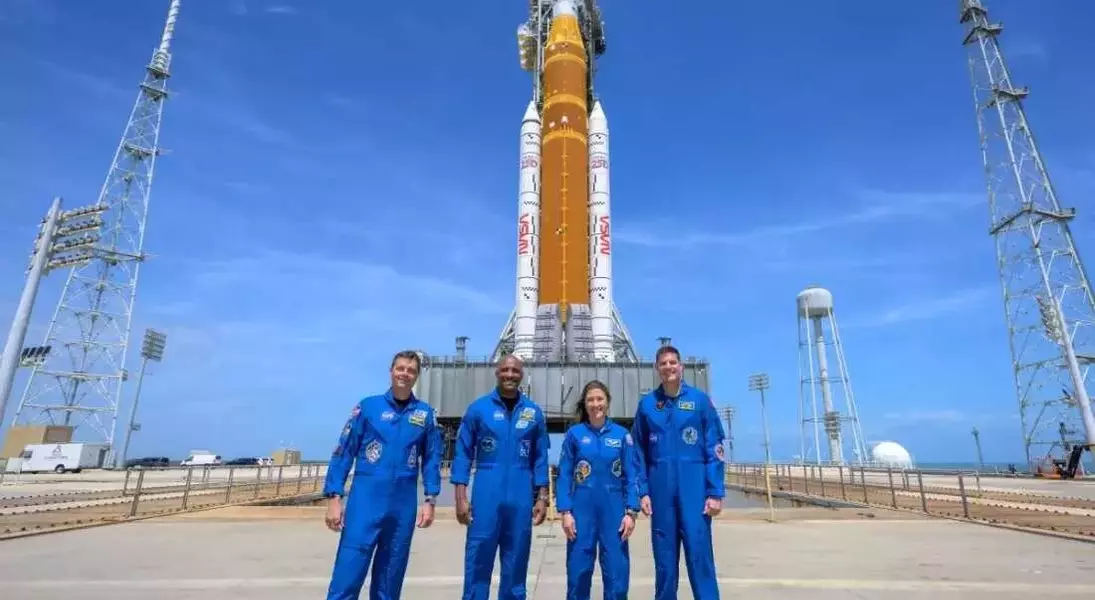
In a groundbreaking endeavor, astronauts are once again journeying towards Earth's celestial neighbor, marking the first human deep-space flight in over five decades. The Artemis II crew, propelled by NASA's formidable SLS rocket, ascended into the Florida sky, leaving a spectacular trail. This mission's primary objective is to thoroughly evaluate the Orion spacecraft's operational capabilities, including its life support and maneuverability, ahead of more ambitious lunar surface missions. The crew, comprising NASA astronauts Reid Wiseman, Victor Glover, Christina Koch, and Canadian Space Agency astronaut Jeremy Hansen, is set to complete a 230,000-mile loop around the Moon, providing invaluable data for future deep space explorations.
During their approximately 10-day expedition, the astronauts will not only test the spacecraft's systems but also become subjects of critical scientific inquiry. Researchers will meticulously collect data on the physiological impacts of extended space travel and increased radiation exposure on the human body, utilizing advanced techniques like placing astronaut cells on microchips within the capsule. Furthermore, the crew will act as geological observers, capturing unprecedented views and photographs of the Moon's far side, an area yet unseen by human eyes. These observations, guided by Earth-based geologists, will contribute significantly to our understanding of lunar geology and aid in the planning of future human landings.
The journey culminates in a high-speed reentry into Earth's atmosphere, where the Orion capsule will endure extreme temperatures of nearly 3,000 degrees Fahrenheit, protected by its heat shield. Lessons learned from previous uncrewed tests have led to adjustments in the reentry trajectory, ensuring enhanced safety for the crew. Upon successful reentry, a series of parachutes will deploy to facilitate a gentle splashdown in the Pacific Ocean, where the astronauts will be recovered. This mission represents a vital precursor to NASA's ambitious plans for increased lunar launches and the establishment of a permanent human presence on the Moon, ushering in a new era of space exploration.
The Artemis II mission epitomizes humanity's unyielding spirit of discovery and innovation. By pushing the boundaries of human spaceflight, we not only expand our scientific knowledge of the cosmos but also inspire future generations to dream beyond our planet. Each step taken towards understanding the Moon and beyond reinforces our collective commitment to exploration, fostering international collaboration and technological advancement that benefits all of humankind. This journey reminds us that the pursuit of knowledge and the courage to venture into the unknown are fundamental to our progress and the betterment of our world.
