
In an era defined by soaring investments in artificial intelligence, companies underpinning this technological revolution are under the spotlight. ASML, a crucial player in advanced chip manufacturing, stands out despite its stock currently trading below its peak. With a unique market position and ambitious growth forecasts, the company is set to capitalize on the increasing global demand for sophisticated computing hardware, making it a potentially lucrative investment for the coming years.
The current landscape of artificial intelligence expenditure is marked by unprecedented growth, with many leading executives anticipating exponential increases in spending over the next half-decade. This surge in AI infrastructure development typically correlates with high valuations for companies poised to profit immensely from this trend. However, ASML Holding, a Dutch firm renowned for its indispensable chipmaking equipment, presents an anomaly. Despite its pivotal role in producing cutting-edge chips, the company's stock has seen a 25% decline from its historical high. This apparent disconnect suggests a significant opportunity for investors, as the company's intrinsic value and future prospects appear to be underappreciated by the market.
ASML's competitive edge stems from its virtual monopoly in the field of extreme ultraviolet (EUV) lithography. These sophisticated machines are essential for etching the microscopic electrical pathways on the most advanced semiconductor chips. As the sole provider of this critical technology, ASML is an unavoidable partner for any chip foundry aiming to scale up its high-end chip production capabilities. Consequently, every new chip fabrication plant constructed globally translates directly into demand for ASML's specialized equipment.
Evidence of this burgeoning demand is abundant. For instance, during a recent earnings call, Nvidia's CEO, Jensen Huang, projected that global data center capital expenditures could reach an astounding $3 trillion to $4 trillion by 2030. A substantial portion of this capital will be allocated to equipping data centers with advanced computing hardware. Components such as Broadcom's networking switches and Nvidia's graphics processing units, which are integral to these data centers, all rely on chips produced using ASML's technology. This direct link to the expanding data center market positions ASML for sustained long-term growth.
With the exponential expansion of data centers, semiconductor manufacturers, including industry giants like Taiwan Semiconductor Manufacturing, are compelled to ramp up their production capacities by establishing new factories. This continuous expansion directly benefits ASML, as these facilities require its specialized lithography machines. The company's leadership team is highly optimistic about its future trajectory, forecasting robust growth over the next five years. Specifically, ASML aims to achieve annual revenues between 44 billion and 60 billion euros by 2030. Given that the company generated 32.2 billion euros in revenue over the past four quarters, hitting the upper end of this projection would signify an almost doubling of its revenue within the next five years. Historically, ASML's management has adopted a conservative approach to its financial guidance, yet its performance has consistently exceeded expectations. For example, in the second quarter, the company reported a remarkable 23% increase in revenue, reinforcing the belief that its 2030 revenue figures could indeed reach the higher end of its guided range, driving significant stock appreciation.
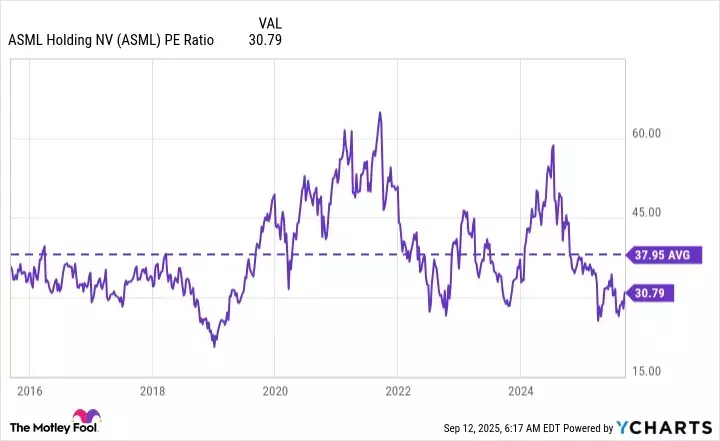
Beyond its impressive revenue growth potential, ASML's current valuation also presents an attractive entry point for investors. Over the last decade, the company's stock has typically traded at an average price-to-earnings (P/E) ratio of approximately 38 times its trailing earnings. Presently, however, ASML's stock is trading below this historical average. Should its P/E ratio revert to its long-term mean, this 'multiple expansion' alone could generate substantial returns for shareholders. Coupled with the anticipated high-end revenue growth by 2030, ASML is positioned as a compelling growth stock for long-term investors.
The company enjoys several powerful tailwinds, with the unprecedented spending on AI infrastructure being the most prominent. A significant advantage for ASML is that foundry operators typically place orders for its machines years in advance of expected demand. This foresight largely insulates the company from the volatility of market bubbles, making ASML a relatively stable and attractive investment vehicle for those looking to participate in the burgeoning AI trend, regardless of their risk tolerance.
