
Atlassian, a prominent software provider, is strategically integrating artificial intelligence into its core product offerings, leading to a notable acceleration in its revenue growth. This move is enhancing business productivity and collaboration, positioning the company as a key player in the evolving tech landscape. Despite its stock trading below its 2021 peak, market analysts are increasingly optimistic about its future prospects, citing substantial potential for appreciation in the coming months. The firm's commitment to AI innovation appears to be a significant driver behind this positive outlook, encouraging businesses to invest more in its advanced solutions.
Atlassian has made significant strides in embedding AI capabilities into its flagship products, Jira and Confluence. Jira, initially developed for software project management, now extends its utility across various non-technical workflows, while Confluence serves as a central hub for organizational knowledge sharing and collaboration. The introduction of Rovo, Atlassian's new AI platform, marks a pivotal moment in this integration. Rovo seamlessly connects with both Jira and Confluence, as well as third-party applications like Microsoft Office 365 and Google Drive, offering a unified information ecosystem.
One of Rovo's standout features is its AI-powered search function, which centralizes disparate information sources, allowing employees to quickly retrieve data using simple prompts, irrespective of its storage location. Furthermore, Rovo Agents empower organizations to create bespoke AI assistants. These agents can automate routine tasks across daily applications, from summarizing meeting discussions and brainstorming marketing ideas to translating content for multinational operations, thereby significantly boosting operational efficiency.
Atlassian's financial performance reflects the positive impact of its AI strategy. In the fiscal fourth quarter of 2025, the company reported a record revenue of $1.38 billion, representing a 22% year-over-year increase. This growth rate surpassed the previous quarter's 14% increase, marking the fastest growth in a year. Notably, annual recurring revenue from its premium and enterprise plans, which include the AI features, surged by an impressive 40% year-over-year, indicating a strong willingness among businesses to invest in these advanced tiers. However, the substantial investment in AI development led to a 20% increase in operating costs, totaling $1.17 billion in Q4, resulting in a GAAP net loss of $23.9 million. On a non-GAAP basis, excluding non-cash expenses like stock-based compensation, the company reported a profit of $259.1 million, a 51% improvement from the prior year. It is worth noting that significant stock-based compensation, while not a cash outflow, dilutes existing shareholders.
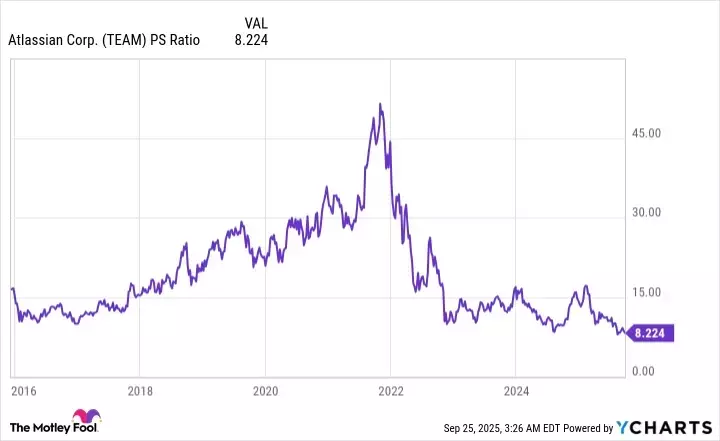
The current market sentiment towards Atlassian stock is overwhelmingly positive. According to analyses by The Wall Street Journal, a substantial majority of the 34 analysts covering the stock have issued either a 'buy' or 'overweight' rating, with no recommendations to sell. The average price target of $246.19 suggests a potential upside of 50% over the next 12 to 18 months, with some analysts forecasting an even higher target of $320, implying a 94% upside. This bullish outlook is further supported by the stock's current valuation; its price-to-sales (P/S) ratio stands at 8.2, a significant decrease from its unsustainable peak of 50 in 2021, and is now near its lowest level since the company's IPO in 2015. Atlassian aims to achieve $10 billion in annual revenue by fiscal year 2029, a goal that appears attainable given its current market traction and an addressable market estimated at $67 billion.
The strong analyst consensus and the company's strategic focus on AI-driven growth suggest that Atlassian's stock is well-positioned for future appreciation. The firm's continuous innovation in productivity software, coupled with the expanding market for AI-enhanced tools, underpins the optimism surrounding its long-term investment potential.
