This article explores Rocket Lab's evolution beyond its core rocket launch services, emphasizing the significant growth and profitability of its space systems division. It delves into the company's new launch infrastructure and its diverse portfolio of spacecraft and satellite components, showcasing its strategic shift towards becoming a holistic provider in the space industry.
Unveiling Rocket Lab's Dual Dominance: Launch Innovations and Profitable Space Systems
Exploring the Significance of Rocket Lab's Latest Launch Facility Inauguration
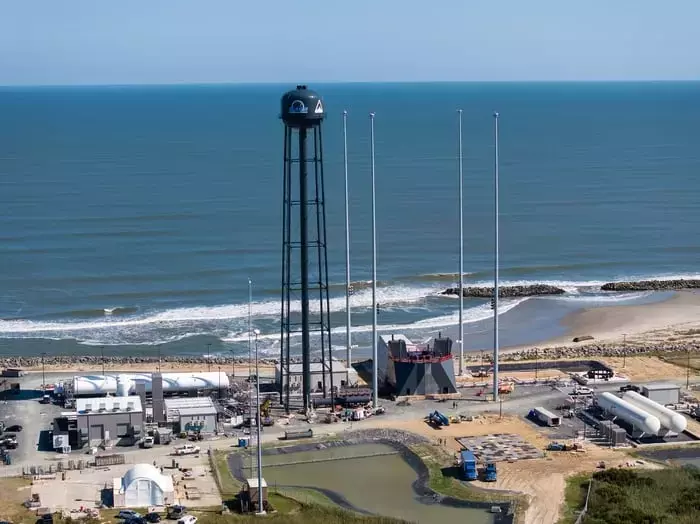
On August 28, the grand opening of Rocket Lab's third launch complex, LC-3, located at the Mid-Atlantic Regional Spaceport (MARS) on Wallops Island, Virginia, marked a pivotal moment. The event was characterized by an enthusiastic gathering of political figures and space agency representatives, who participated in the ceremonial ribbon-cutting. Attendees were also treated to an immersive tour of the advanced launch facilities, which included a live demonstration of the impressive water deluge system. This system features a towering 283-foot structure designed to discharge 200,000 gallons of water onto the launch pad, mitigating the heat, noise, and vibrations generated during the launch of a Neutron rocket.
The Strategic Importance of Diversification Beyond Rocketry for Future Growth
Hours following the celebratory proceedings, a deeper insight into Rocket Lab's strategic direction emerged from a detailed 62-page promotional booklet. This document elucidated how the new LC-3 facility and the Neutron rocket are integral to transforming Rocket Lab into a comprehensive "end-to-end space company." The vision outlined involves offering a broad spectrum of products and services, from spacecraft components and software to complete spacecraft and their payloads, alongside launching these assets into orbit and subsequently recovering the rockets for reuse. The extensive details within the brochure unveiled surprising aspects of the company's diversified approach.
Unpacking Rocket Lab's Extensive Portfolio Beyond Propulsion Systems
While Rocket Lab is primarily recognized for its advanced rocket technology, its operational scope extends significantly beyond this core function. The Electron small rocket currently stands as the second most frequently launched vehicle in the United States, surpassed only by SpaceX's Falcon 9. The upcoming Neutron rocket, slated for launches from LC-3, is poised to become the nation's third most active launcher, contending with formidable competitors such as ULA's Vulcan and Blue Origin's New Glenn. Beyond launch services, Rocket Lab has cultivated a robust "space systems" division. This segment is experiencing rapid expansion, paralleling the growth of its launch services, and has, in fact, surpassed launch services in terms of revenue generation. The full extent of Rocket Lab's diversified space systems offerings has recently become more apparent.
A Comprehensive Overview of Rocket Lab's Advanced Spacecraft Designs
Rocket Lab's promotional literature dedicates a mere ten pages to its rockets and rocket engines, with the vast majority of the brochure detailing its array of non-rocket products, including five distinct spacecraft models:
The Pioneering Photon Satellite: A Legacy of Orbital Delivery
The Photon satellite, often considered Rocket Lab's inaugural spacecraft, is an evolution of the company's "Kick Stage" technology. It specializes in precise orbital insertion for various payloads, showcasing its capability to place assets accurately in their final intended orbits.
Pioneer Spacecraft: Enabling Atmospheric Reentry and Scientific Return
The Pioneer spacecraft boasts advanced steering capabilities, enabling controlled atmospheric reentry. These vehicles are instrumental in facilitating the return of Varda Space Industries' space-based pharmaceutical experiments back to Earth, highlighting their role in scientific recovery missions.
Explorer Series: Charting New Territories in Interplanetary Discovery
Designed for ambitious deep-space interplanetary missions, the Explorer series of spacecraft is set to play a crucial role in the upcoming ESCAPADE mission to Mars. Their robust design and navigational precision are tailored for the rigors of extended journeys across the solar system.
Lightning Spacecraft: The Backbone of High-Performance Defense Systems
The Lightning spacecraft, engineered for exceptional reliability and high power output, represents a cornerstone in Rocket Lab's most substantial contract to date: a $515 million assignment to develop a sophisticated missile detection system for the Space Force. Their design emphasizes resilience and operational efficiency under demanding conditions.
Flatellite Technology: Revolutionizing Satellite Constellation Deployment
The innovative Flatellite, a recent development, is ingeniously designed for seamless stacking within a rocket fairing. This design facilitates the efficient deployment of orbital satellite constellations, particularly for critical communication networks, by optimizing space and streamlining launch procedures.
Rocket Lab's Crucial Role in Supplying Advanced Satellite Components
In addition to manufacturing its own satellites, Rocket Lab also serves as a vital supplier of components to other entities engaged in satellite construction. These "satellite parts" encompass a wide array of essential technologies, ranging from solar panels for power generation and radio systems for communication, to star trackers for precise navigation and reaction wheels for accurate orientation control. Furthermore, Rocket Lab develops infrared and electro-optical systems that enable satellites to conduct imaging and observation tasks, alongside separation systems for rocket stages and dispensing mechanisms for payload deployment in orbit. The company also provides the sophisticated software necessary to manage and coordinate all these advanced functionalities.
The Strategic Importance and Profitability of Rocket Lab's Component Business
Rocket Lab dedicates approximately half of its marketing materials to its extensive rocket components division, which resembles a celestial hardware catalog due to its sheer breadth. This emphasis is well-founded, as the space systems segment, encompassing both complete spacecraft and individual satellite components, stands as Rocket Lab's largest business. With $310 million in sales projected for 2024, this division is more than double the size of its launch services counterpart. Moreover, space systems is also Rocket Lab's most lucrative sector. Although S&P Global Market Intelligence data indicates that launch services temporarily matched space systems in profitability in 2024, achieving a gross profit margin of 27.5%, space systems regained its lead in 2025 with a 32.5% gross profit margin—a 650 basis point advantage over launch services, which saw its margin retract to 26%. This scenario, combined with a higher growth rate (35% for space systems versus 32% for launch services in the first half of 2025), suggests that Rocket Lab is expanding its more profitable ventures at a faster pace. Should Rocket Lab achieve its analyst-projected GAAP profitability by 2027, the Neutron rocket will undoubtedly contribute, but the space systems division is poised to be an even more significant driver of this financial milestone.
