Historically, photography has often been perceived as a medium of objective truth, yet its portrayal of blind individuals frequently falls prey to ingrained societal biases. This analysis examines works by Jacob Riis, Paul Strand, and Walker Evans, revealing how their lenses, despite their creators' intentions, often reinforced stereotypical narratives of vulnerability or suffering associated with blindness. Through a critical lens, this exploration advocates for a deeper understanding, one that moves beyond mere visual interpretation to acknowledge the rich, complex experiences of blind individuals, challenging the viewer to 'see' with more than just their eyes and to dismantle ocularcentric perspectives that limit true comprehension.
The Unseen Narratives: A Deeper Look at Photographic Portrayals of Blindness
In the late 19th and early 20th centuries, pioneering photographers Jacob Riis, Paul Strand, and Walker Evans each captured indelible images of blind individuals, inadvertently sparking a century-long dialogue on perception, bias, and the limitations of visual representation. Their works, while iconic, prompt us to question whether photography truly reveals objective truth or merely reflects the photographer's and society's preconceptions.
Jacob Riis, in 1887, ventured into the dimly lit tenements of New York City, armed with his revolutionary flashlight powder. His mission, as documented in his seminal work, How the Other Half Lives (1890), was to expose the harsh realities of poverty. Within this collection, the photograph 'Upstairs in Blind Man’s Alley' stands out. This alley, located at 26 Cherry Street on Manhattan's Lower East Side, was named for its colony of blind beggars, tenants of the affluent Daniel Murphy. Riis's dramatic photographic process, including an incident where his flash nearly ignited the tenement, highlights the inherent risks and intrusive nature of his documentary style. From the perspective of a blind person, one might imagine the heat of the flash and the underlying sense of peril, questioning the true impact of such an exposé on those it aimed to portray.
Nearly three decades later, in 1916, Paul Strand patrolled the bustling streets of New York with a concealed camera, equipped with a prism lens that allowed him to photograph subjects discreetly. On a crisp autumn day, he encountered a blind woman selling newspapers. The resulting image, initially titled 'New York, 1916' and later renowned as 'Blind Woman,' became one of the 20th century's most potent photographs. This close-up portrays a woman in a dark tunic and headscarf, her neck adorned with a prominent 'BLIND' sign and a badge identifying her as a 'licensed peddler and New York City.' The visual details, such as her partially closed, cloudy right eye and her gaze seemingly directed beyond the frame, invite complex interpretations. The arduous process of obtaining a peddler's license, as evidenced by a 1921 New York Times article, underscores the bureaucratic struggles faced by marginalized individuals, adding an unseen layer of narrative to Strand's static image.
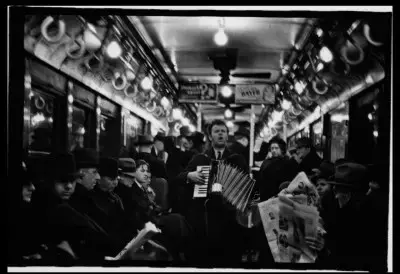
Finally, Walker Evans's 1938 photograph of a blind accordion player on a New York City subway platform continues this exploration. Described by some as exuding profound unhappiness, others perceive a performer deeply engrossed in his art, his animated expression contrasting sharply with the passive commuters surrounding him. This particular image stands apart from Evans's other subway portraits, where he covertly photographed passengers. The accordion player, perhaps perceived as unable to 'look back,' allowed Evans a different kind of photographic freedom, raising questions about the photographer's gaze and the power dynamics embedded in such encounters.
These three powerful photographs, each capturing anonymous blind individuals, collectively challenge our understanding of vision and knowledge. They force us to confront the limitations of photography's 'truth' and the pervasive societal tendency to equate blindness with suffering. As author Bojana Coklyat astutely asks, 'how much are we missing by just looking?' By engaging with these images through a critical, empathetic lens, one that resists preconceived notions of pity or vulnerability, we can unlock new dimensions of perception and knowledge, fostering a more inclusive and nuanced appreciation of the human experience.
These iconic images of blind individuals serve as a profound reminder that what we 'see' is often filtered through our own biases and societal constructs. The photographers, despite their artistic prowess, sometimes inadvertently perpetuated stereotypes, equating blindness with hardship or helplessness. However, by engaging with these photographs with a critical and empathetic perspective, we, as viewers, are prompted to challenge our own ocularcentric worldviews. We are encouraged to move beyond mere visual information, recognizing that a person's life, especially one marked by disability, encompasses a spectrum of experiences far richer and more complex than a single frame can convey. This process of re-evaluation allows us to develop a deeper, more nuanced understanding of human dignity, resilience, and the myriad ways individuals navigate and enrich the world, irrespective of their sensory perceptions.