
In the vibrant landscape of artificial intelligence (AI) investments, where the S&P 500 and Nasdaq Composite frequently reach new peaks, many stocks exhibit elevated valuations. Within this context, defense technology firm BigBear.ai, with its modest share price, might initially appear as an attractive alternative to market leaders like Palantir Technologies. However, a deeper examination reveals that appearances can be misleading when assessing true investment value.
BigBear.ai's Valuation: A Deeper Look into the AI Defense Sector
The artificial intelligence sector has experienced an unprecedented surge, pushing market indices to historic highs. In this environment, BigBear.ai, trading at a seemingly low price per share, presents itself as a potential hidden gem, especially when contrasted with industry giants such as Palantir Technologies and C3.ai. However, savvy investors understand that a low share price alone does not signify undervaluation. A more comprehensive analysis involves benchmarking a company against its peers using metrics like the price-to-sales (P/S) ratio to truly ascertain its market position and inherent worth.
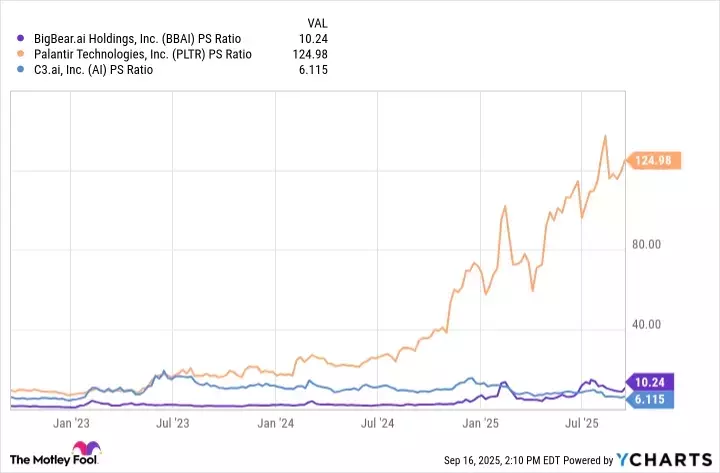
Examining the P/S ratios within the defense tech domain, Palantir has notably expanded its valuation during the AI boom, significantly outperforming its competitors. In contrast, BigBear.ai's P/S multiple, though seemingly reasonable at 10.2, tells a different story. Valuation multiples are not static figures; they intricately reflect a company's growth prospects, the sustainability of its profits, and its competitive standing. Before hastily labeling BigBear.ai as an undervalued prospect, it's crucial to delve into the specific dynamics that shape each company's trajectory.
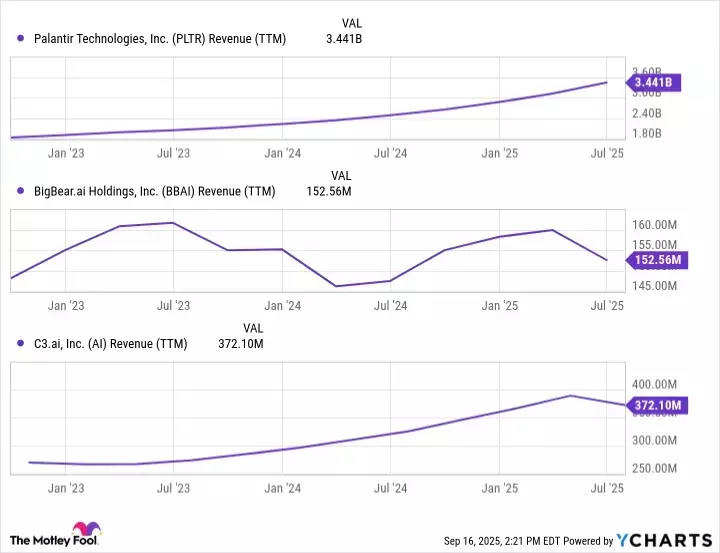
The narrative of BigBear.ai as the 'next Palantir' has progressively weakened over time. Palantir has consistently secured lucrative multi-year, multi-billion-dollar contracts with entities like the U.S. Army, NATO allies, and critical agencies such as Immigration and Customs Enforcement (ICE). These significant achievements have propelled Palantir's revenue growth, illustrating a robust and expanding market presence. Conversely, BigBear.ai and C3.ai have largely been confined to smaller, more specialized market segments, leading to decelerated growth and, in some instances, declining momentum. This divergence suggests that Palantir is actively establishing a formidable competitive moat, making it increasingly challenging for BigBear.ai to gain significant traction.
Therefore, BigBear.ai's discounted valuation, rather than indicating a missed opportunity, serves as a clear reflection of its underlying competitive disadvantages and operational hurdles. This situation highlights the importance of distinguishing between a low stock price and a truly sound investment opportunity. While BigBear.ai has existing contracts and operates in a high-demand sector, its depressed valuation appears justified by its challenges in competing with Palantir's market dominance.
Investment Outlook: Separating Value from Speculation
For investors, the critical task is to differentiate between a genuinely undervalued asset and a speculative play. BigBear.ai's current valuation, though low, seems to accurately reflect its operational headwinds in the shadow of Palantir's commanding presence. Consequently, viewing BigBear.ai as a long-term core investment at its current levels carries considerable risk. It is perhaps better categorized as a short-term speculative trade rather than a stable, buy-and-hold portfolio component.
