
Billionaire investor Bill Ackman, at the helm of Pershing Square Capital Management, employs a focused investment philosophy, typically holding a concise portfolio of 10 to 12 stocks. This concentrated approach enables his team to conduct extensive, bottom-up research into each company they invest in. A prime example of this strategy is their long-term position in Restaurant Brands International (QSR), a company that has not only been a cornerstone of their portfolio for over a decade but also provides substantial passive income annually. Despite facing market challenges such as intense competition, supply chain disruptions, and inflationary pressures, Ackman's conviction in QSR's robust franchise model and its ongoing strategic initiatives, particularly the revitalization of Burger King, remains strong. The attractive dividend yield offered by QSR further sweetens the deal for investors, providing consistent returns while awaiting the full realization of the company's long-term growth potential.
Bill Ackman, a renowned figure in the hedge fund landscape, has garnered considerable attention for his distinct investment style. His fund, Pershing Square Capital Management, which manages Pershing Square Holdings, reported an impressive five-year return of approximately 121% net of fees by the end of August. This success is largely attributed to their meticulous investment process, which involves an exhaustive analysis of a limited number of companies. As of the second quarter's close, Pershing Square's portfolio contained just ten companies, reflecting their commitment to deep research over broad diversification.
Among these carefully selected holdings, Restaurant Brands International (QSR) stands out. Pershing Square has maintained an investment in QSR since its initial public offering in 2012. QSR is the parent company of iconic fast-food brands such as Burger King, Tim Horton's, and Popeye's. While QSR's stock performance has been modest over the past five years, climbing only about 13%, the company has navigated a complex operating environment characterized by fierce market rivalry, supply chain complexities, and rising inflation. Furthermore, QSR carries a significant debt load of approximately $13.4 billion, resulting in a high debt-to-equity ratio exceeding 4 as of the second quarter.
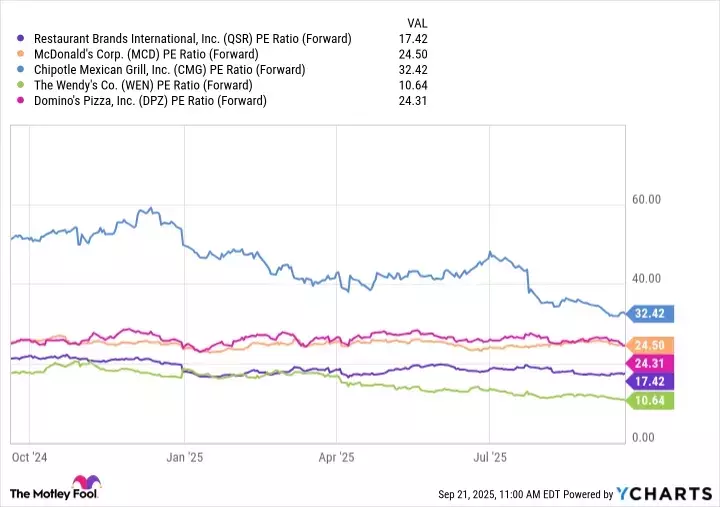
Despite these headwinds, Ackman and his team remain bullish on QSR. In a recent communication to shareholders, they highlighted their appreciation for QSR's 'high-quality, capital-light' franchise model. This model generates substantial royalties from its leading fast-food brands, which include a Burger King International segment that recently outperformed McDonald's in same-store sales growth, achieving over 4% year-over-year expansion. Pershing Square also expresses optimism regarding the ongoing revamp of Burger King's U.S. operations. A key component of this strategy was QSR's acquisition of Carrols Restaurant Group in 2024, which is the largest Burger King franchisee in the U.S. with more than 600 locations. QSR plans to invest an additional $500 million into these restaurants to modernize them, subsequently re-franchising them. The fund also notes that QSR trades at a discount compared to its industry peers based on its forward price-to-earnings ratio.
While Pershing Square patiently observes the unfolding of QSR's long-term strategic plans, the company's robust dividend payments offer a substantial source of passive income. QSR has consistently delivered a high dividend yield, which stood at approximately 3.90% over the past 12 months. After introducing a modest dividend in 2015, QSR significantly increased it in 2018 and has continued to grow it steadily each subsequent year. In the first half of the year, QSR distributed $544 million in dividends, projecting an annual dividend run rate of roughly $1.09 billion. This is well supported by its free cash flow, which amounted to $1.35 billion over the last 12 months. Although net income for the first six months, at $484 million, was below the dividends paid, this is largely attributed to elevated restaurant expenses, including costs for food, beverages, packaging, wages, and occupancy. Management acknowledges the particularly high beef prices but views food prices as cyclical, anticipating future normalization. As of the second quarter, Pershing Square's investment in QSR totaled $1.52 billion, translating to an estimated $59.5 million in annual dividends, underscoring the value of patient investing in high-quality dividend-paying companies.
