This analysis contrasts Bitcoin and XRP, two significant digital currencies, by examining their core attributes and market positions. Despite XRP's notable price increase, outperforming Bitcoin in early 2025, it is argued that XRP will not replicate Bitcoin's investment trajectory. The discussion centers on Bitcoin's established status as a scarce, decentralized asset serving as a hedge against inflation and a store of value. In contrast, XRP's primary function is to revolutionize cross-border payments through efficiency and reduced costs. Understanding these fundamental differences is crucial for investors evaluating their roles within the broader cryptocurrency ecosystem.
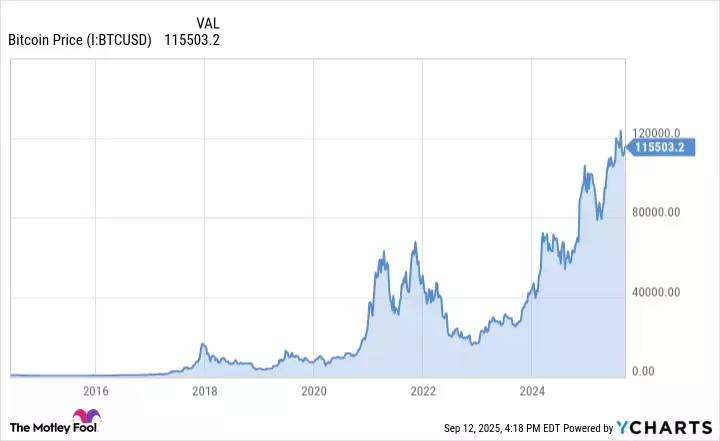
A handful of digital currencies consistently dominate discussions within the evolving cryptocurrency landscape. Among these, Bitcoin and XRP stand out as two of the most recognized participants in the market. By September 12, XRP had demonstrated an impressive 48% increase year-to-date, precisely double Bitcoin's gains during the same period. This significant upward trend might lead investors to question if XRP is poised to become the next major contender in the crypto space, rivaling Bitcoin's influence and investment appeal.
Bitcoin's fundamental allure is rooted in its inherent scarcity. With a strictly limited supply of 21 million coins, it is designed to be a deflationary asset, sharply contrasting with traditional fiat currencies that can be issued indefinitely. This structural difference has led many financial experts to label Bitcoin as \"digital gold,\" emphasizing both its rarity and the computational effort required for its creation. Beyond its scarcity, Bitcoin's growing adoption in corporate treasury management further solidifies its position. Major companies, including Strategy (formerly MicroStrategy) and GameStop, have integrated Bitcoin into their balance sheets as part of their cash management strategies. On an even grander scale, several nations are exploring the establishment of strategic Bitcoin reserves, mirroring corporate practices but on a global and more sophisticated level. These developments underscore Bitcoin's pervasive influence, increasingly seen not only as a reliable store of value but also as a safeguard against inflation and a tool to mitigate systemic financial risks.
Conversely, XRP has carved out a distinct niche in the digital currency world, specifically targeting global payments. The current interbank financial telecommunication network, SWIFT, handles cross-border transactions for thousands of businesses. However, many consider SWIFT's infrastructure to be slow and costly, with businesses often incurring substantial foreign exchange fees and enduring multi-day settlement periods. XRP seeks to alleviate these challenges by offering nearly instantaneous processing and minimal transaction fees. Given that the global market for cross-border transactions is valued in trillions of dollars annually, XRP possesses a vast opportunity, positioning it with tangible, disruptive utility. Yet, a crucial caveat exists: XRP transactions are primarily conducted on the Ripple network. While Ripple has successfully cultivated partnerships with banks and financial institutions, the adoption of its infrastructure does not automatically translate into widespread usage of the XRP token. This implies that Ripple's success as a payment platform does not necessarily generate proportional demand for XRP itself.
Considering these analyses, it becomes clear that Bitcoin and XRP fulfill fundamentally different roles within the digital asset ecosystem. Bitcoin functions as a macro asset, serving as a hedge against inflation, a reserve instrument, and a potential bargaining chip in global economic discussions. In stark contrast, XRP focuses on a more specialized application: improving the speed and reducing the cost of international payments. These distinctions are vital for investors to comprehend. Bitcoin's intrinsic value is derived from its scarcity and its unique status as a decentralized, multi-platform store of value. XRP's value proposition, however, originates from its ability to enhance efficiency in an industry ripe for innovation, even though the use of its token is not always a mandatory component of that efficiency. While XRP undeniably offers clear utility and has the potential to capture a significant share of the expanding payments market, its investment profile should not be equated with Bitcoin's. Bitcoin is increasingly gaining traction in the realm of alternative assets, whereas XRP remains an application-driven opportunity with specific demand requirements.
