
Following its latest earnings announcement, Chewy's stock experienced a notable decline, a reaction primarily driven by concerns over increased operating expenses. However, a deeper look into the company's performance reveals a more optimistic picture. Chewy not only surpassed revenue expectations but also updated its full-year revenue forecast upwards, showcasing its resilience and growth potential. Despite the market's initial negative sentiment, key financial indicators like strong autoship sales, improving gross margins, and healthy free cash flow suggest that the sell-off might be an overreaction. Investors could view this dip as an opportune moment to acquire shares in a company with solid underlying business fundamentals and attractive long-term prospects.
Chewy's shares saw a significant plunge after its recent earnings release, primarily due to a larger-than-anticipated rise in operational costs. This led to its earnings before interest, taxes, depreciation, and amortization (EBITDA) being slightly below predictions. While some media outlets highlighted a drop in GAAP earnings, this was largely influenced by a one-time tax benefit from the previous year, a factor professional investors often overlook. The underlying issue of increased operating expenses, while a concern, is generally manageable for a company with Chewy's established business model, which inherently carries high fixed costs.
The company demonstrated impressive revenue growth, with sales soaring by nearly 9% year-over-year to $3.1 billion in its fiscal second quarter, exceeding earlier forecasts. This strong performance is underpinned by the consistent demand for pet consumables and medication, which constitute the majority of Chewy's sales. A significant portion of its revenue, over 80%, comes from its autoship program, which allows customers to schedule regular deliveries. Autoship sales alone climbed by nearly 15% to $2.6 billion, highlighting the loyalty and recurring nature of its customer base. Furthermore, Chewy successfully onboarded 150,000 new active customers in the quarter, and the net sales per active customer (NSPAC) grew by 5% to $591, indicating increased customer spending.
Despite the strong revenue growth, operating expenses, particularly selling, general, and administration (SG&A) costs, increased by 8%. This led to a slight SG&A deleveraging, which disappointed investors who are keen on seeing greater operating leverage. However, management has expressed confidence in achieving modest SG&A leverage for the year, expecting cost growth to moderate in the latter half. The adjusted earnings per share (EPS) saw a substantial 38% increase to $0.33, aligning with guidance. Moreover, adjusted EBITDA rose by 27% year-over-year to $183.2 million, demonstrating underlying profitability. The company also maintained a robust financial position, generating $106 million in free cash flow and executing a $125 million stock buyback, ending the quarter with nearly $591.8 million in cash and no debt.
Looking forward, Chewy projects fiscal third-quarter revenue growth of 7% to 8%, with adjusted EPS ranging from $0.28 to $0.33, up from $0.20 in the prior year. For the full fiscal year, the company revised its revenue guidance upwards to between $12.5 billion and $12.6 billion, while keeping its adjusted EBITDA margin guidance at 5.4% to 5.7%. These projections, combined with strategic initiatives such as the expansion of high-margin sponsored ads and a paid membership program similar to those of Amazon and Walmart, bode well for future profitability. Chewy is also venturing further into private brands, exemplified by its new 'Get Real' fresh dog food line, which typically offers higher margins and enhances brand loyalty.
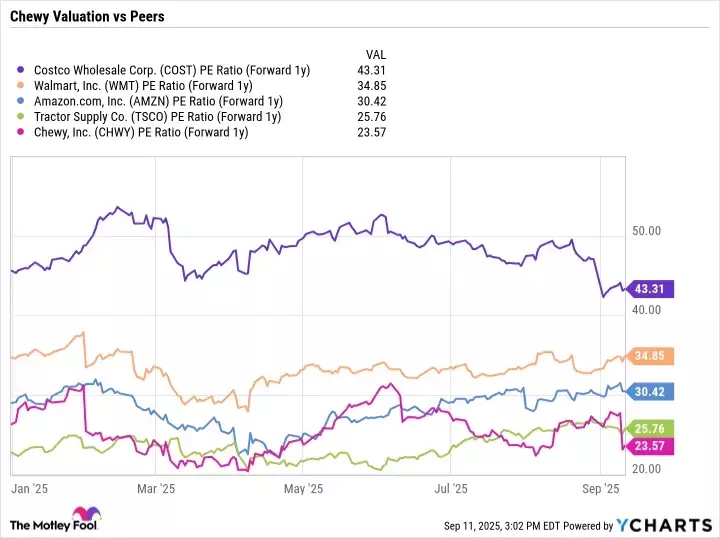
From an investment standpoint, Chewy's current valuation appears appealing. The stock trades at a forward price-to-earnings (P/E) ratio of approximately 23.5, based on next-year analyst estimates. This positions it at a discount compared to other recession-resistant retailers such as Costco, Walmart, and Tractor Supply, as well as e-commerce behemoth Amazon. Given the company's solid fundamentals, consistent growth in key areas, and strategic moves to bolster margins, the recent stock price correction seems unwarranted. The ability to manage and eventually reduce operating expenses is a common challenge that many businesses successfully navigate. Therefore, this temporary setback could represent a compelling buying opportunity for investors seeking long-term value in the pet supplies market.
