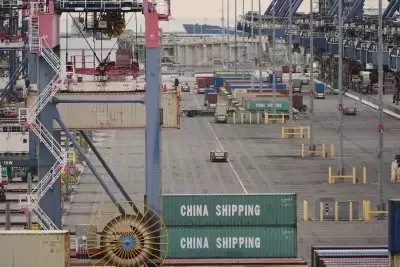
In a landmark ruling, the Supreme Court has invalidated President Donald Trump's extensive tariffs, sparking a scramble among businesses to reclaim an estimated $133 billion in import taxes. This decision, delivered on Friday, leaves a significant question regarding the fate of these collected funds. Legal professionals foresee a convoluted and drawn-out process for companies seeking refunds, involving various governmental and judicial bodies. While the ruling offers a potential economic boost through eased inflationary pressures and increased spending, the path to restitution is expected to be anything but smooth, with widespread litigation anticipated.
The Supreme Court's 6-3 decision on Friday centered on the former president's use of the 1977 International Emergency Economic Powers Act (IEEPA) to impose these levies. The court determined that this act did not grant the president the authority to impose such taxes, a power explicitly reserved for Congress. Notably, two of the three justices appointed by Trump sided with the majority, marking a significant setback for a key part of his previous administration's economic policy.
By mid-December, the U.S. Customs agency had already accumulated $133 billion through these IEEPA tariffs. However, the prospect of consumers receiving refunds for the increased prices they bore due to these tariffs remains low. Instead, these reimbursements are more likely to be directed towards the companies that initially paid the import duties.
Justice Brett Kavanaugh, in his dissenting opinion, criticized his colleagues for sidestepping the refund issue, highlighting the immense complexity. He echoed Justice Amy Coney Barrett's earlier assessment, predicting that the refund process would be a 'mess.' Former President Trump, reacting to the decision, expressed his disappointment and anticipated years of legal battles.
Trade lawyers indicate that the refund mechanism will likely be a collaborative effort involving the U.S. Customs and Border Protection agency, the Court of International Trade in New York, and other lower courts. Joyce Adetutu, a partner at Vinson & Elkins, emphasized the substantial sum of money involved, predicting a challenging period for both the courts and importers.
While the nullification of these tariffs could offer some relief to inflationary pressures and stimulate economic growth, the effects are expected to be moderate. Most nations will continue to face specific sector tariffs from the U.S., and former President Trump has indicated intentions to implement alternative tariff strategies. The actual distribution of refunds is projected to take 12 to 18 months, according to TD Securities.
The U.S. customs agency possesses an existing framework for refunding duties in cases of demonstrable error. Experts like Dave Townsend of Dorsey & Whitney suggest that this system might be adapted for the IEEPA tariff refunds. Historically, courts have established refund systems in trade cases, such as the unconstitutional harbor maintenance fee in the 1990s. Nevertheless, the current situation, involving thousands of importers and billions of dollars, is unprecedented in its scale.
Legal professionals also anticipate further litigation. For instance, manufacturers might sue for a share of refunds granted to suppliers who increased raw material prices to offset the tariffs. Alexis Early, a partner at Bryan Cave Leighton Paisner, noted that the government's difficulty in administering refunds does not justify withholding unlawfully collected fees, and warned of potentially years of ongoing litigation across multiple jurisdictions. While consumers technically have the right to file lawsuits, Early advises against it due to the minimal likelihood of recouping individual overpayments.
State-level efforts to claim refunds are already underway. Illinois Governor JB Pritzker, a Democrat, has demanded a refund on behalf of his state's households, citing an estimated $8.7 billion in costs due to the tariffs. Similarly, Nevada Treasurer Zach Conine has submitted a request for $2.1 billion. These actions underscore the widespread financial implications and the anticipated contentious legal landscape following the Supreme Court's ruling.
The Supreme Court's recent decision to strike down President Trump's major tariffs has set the stage for a complex and potentially turbulent period of financial reconciliation. Businesses are now poised to seek the return of significant sums, leading to an intricate process that will likely involve extensive legal proceedings. This development is expected to shape the economic landscape, with an emphasis on how these substantial refunds will be managed and distributed across various stakeholders.
