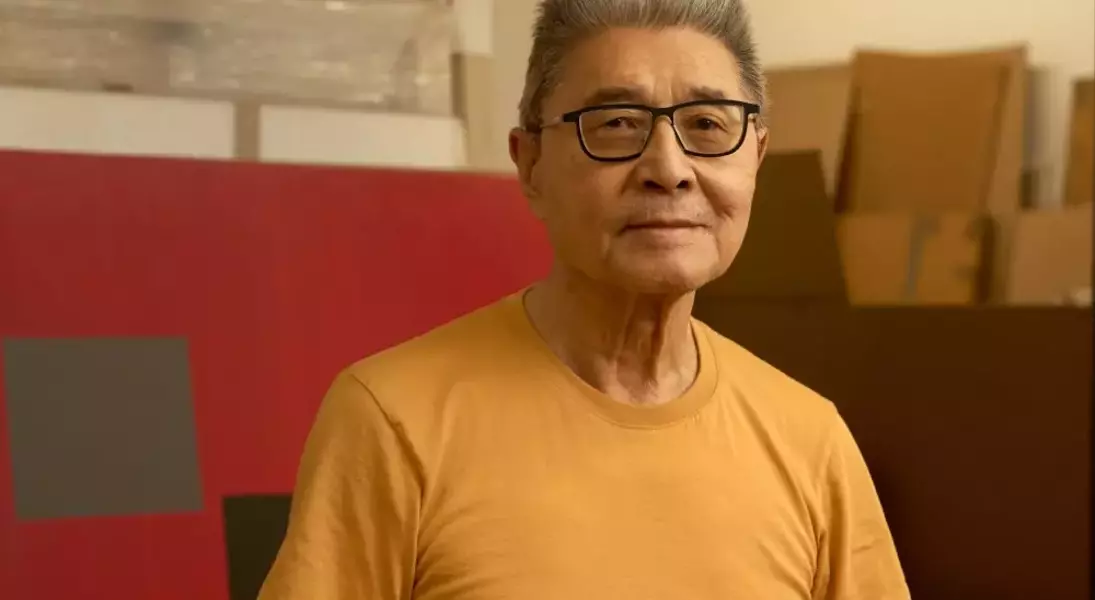
Artist David Diao elaborates on the conceptual underpinnings and creative journey behind his painting, "Bauhaus Still Looking to De Stijl," prominently featured on the Fall cover of Art in America. Diao reveals his artistic philosophy, centered on integrating historical narratives and metaphorical resonance into his abstract creations. He traces the painting's lineage to an earlier work from 1987, explaining how it reinterprets and expands upon themes from the Bauhaus and De Stijl movements. Furthermore, Diao shares insights into his deliberate use of color as a subjective yet integral element, and how a touch of humor imbues his work with a distinctive lightness, ensuring that his art remains engaging and thought-provoking.
Diao's distinctive artistic method involves sourcing images imbued with metaphorical depth and historical significance, which he then transforms into abstract forms. His aspiration is to imbue his abstractions with a rich, historically connected narrative, transcending mere visual representation. This approach, refined since his 1984 painting "On Our Land," which provocatively juxtaposed the Palestinian flag with Suprematist abstraction, reflects a continuous exploration of art's capacity to convey deeper meanings. The current painting, an evolution of his 1987 work "Bauhaus Looks to De Stijl," exemplifies this continuity, showcasing how Diao revisits and recontextualizes his ideas over time, ensuring their enduring relevance and impact within the contemporary art discourse.
The Evolution of Abstraction: Diao's Vision
David Diao, a prominent figure in the art world, delves into the intricate details of his painting, "Bauhaus Still Looking to De Stijl," which graces the cover of the Fall issue of Art in America. He articulates his unique artistic methodology, emphasizing his pursuit of imagery that carries both metaphorical weight and historical context, serving as foundational elements for his abstract compositions. Diao expresses a desire for his abstract pieces to possess a profound historical narrative, moving beyond purely abstract forms to convey a more focused meaning. This philosophy, he notes, has been a cornerstone of his practice since 1984, following a significant period of artistic hiatus that culminated in his impactful work, "On Our Land." This painting, which paired the Palestinian flag with a Suprematist design, marked a pivotal moment, leading him into a deep engagement with the legacy of Malevich and the broader history of modern art. His current cover piece is a testament to this enduring commitment to infusing abstraction with layered historical and personal resonance.
The painting, "Bauhaus Still Looking to De Stijl," is a revisited and re-envisioned version of his earlier work from 1987, titled "Bauhaus Looks to De Stijl." Diao elaborates on the deliberate inclusion of specific visual elements: a profile icon of the Bauhaus, designed by Vilmos Huszár, positioned on the left, and a deconstructed Red Blue Chair by Gerrit Rietveld on the right, stripped of its original black struts. The artist highlights the historical interconnectedness between Bauhaus and De Stijl, noting that figures like Huszár bridged both movements. He holds Rietveld in high esteem, recognizing his significant contributions as an artist beyond his renowned status as a designer. Diao reveals a personal connection to Rietveld's work, owning several copies of his chairs, including one acquired through a trade and another reconstructed for various paintings. He also discusses his intentional use of color as a subjective yet vital component, often employing monochrome grounds to create depth. For instance, the background of the chair in the painting is subtly blue, compensating for the absent blue elements of the chair in the visual representation. This approach ensures that even minor incidents within the background contribute to the overall narrative, creating a visually rich and intellectually stimulating artwork that transcends its abstract facade.
Interweaving History and Modernism in Art
David Diao's artistic practice is profoundly shaped by his inclination to revisit and re-evaluate past works, particularly when their core ideas retain contemporary relevance. His painting, "Bauhaus Still Looking to De Stijl," serves as a prime example of this approach, building upon a 1987 predecessor. Diao meticulously integrates elements that symbolically represent the Bauhaus and De Stijl movements: the iconic Bauhaus profile on the left, attributed to Vilmos Huszár, and a modified Red Blue Chair by Gerrit Rietveld on the right, presented without its typical structural supports. The artist finds satisfaction in the dual interpretation of the piece, where it can be perceived as both an abstract composition and a recognizable facial form. He emphasizes the historical symbiosis between the two art movements, pointing out how certain artists, including Huszár, were integral to both. Diao's admiration for Rietveld extends beyond his architectural and design achievements, recognizing his equal standing among fine artists. This deep engagement with art history, combined with his personal collection of Rietveld chairs, underscores the profound influence of these movements on his creative output.
Diao's engagement with color is another critical aspect of his work, often serving as the most subjective and expressive element. He aims for colors to be visually striking and aesthetically pleasing, viewing his entire body of work through the lens of monochrome painting. This perspective stems from his practice of preparing a base layer before superimposing any additional imagery, creating a foundational depth. In "Bauhaus Still Looking to De Stijl," the background features a barely perceptible blue plane within the chair's depiction, intentionally chosen to stand in for the chair's missing blue components. This subtle detail demonstrates his meticulous attention to how color can convey meaning and nuance, even in its most understated forms. The background, therefore, is not a flat, uniform blue but possesses an inherent incident, adding complexity to the visual narrative. Diao also mentions creating a lithograph version of this image in 2019, driven by his affection for the piece and a desire for its wider dissemination. He concludes by stressing the importance of humor in his art, suggesting that a light-hearted approach keeps the creative process vibrant and prevents it from becoming overly solemn, ultimately enriching the viewer's experience.
