
This article examines the enduring belief in the \"October effect\" within the stock market, where the month of October is often associated with significant downturns and financial crises. It delves into historical events that have fueled this perception, such as the panics and crashes of past centuries. However, the analysis then shifts to contemporary market behavior, particularly focusing on recent performance trends of the S&P 500. The piece evaluates whether the historical narrative holds true in the modern investment landscape, considering factors like current economic conditions, interest rate policies, technological advancements, and market valuations. Ultimately, it aims to provide investors with a balanced perspective, encouraging a focus on long-term strategies over seasonal anxieties.
Unmasking the \"October Effect\": A Reality Check for Investors
Historical Echoes: The Market's October Scares
Historically, the month of October has been linked to significant market turmoil, leading to widespread investor apprehension. Landmark events such as the Panic of 1907, the infamous Black Tuesday of 1929, and the more recent Black Monday in 1987 have etched a narrative of fear around this particular month. These episodes have collectively given rise to the concept of the \"October effect,\" a prevailing notion that stock markets are inherently prone to dips during October.
Contemporary Gains: Challenging the Narrative
Despite the lingering historical concerns, recent market trends suggest a more nuanced reality. The S&P 500, for instance, has demonstrated robust growth, recently achieving unprecedented highs. September, a month also traditionally viewed with skepticism by investors, concluded on a positive note with a 3.5% gain, setting the index on course for an impressive annual increase of 14%. This recent performance prompts a critical examination of whether the long-standing \"October effect\" truly holds sway over present-day market dynamics.
Driving Forces Behind Recent Market Optimism
Several key factors have underpinned the market's recent ascent, particularly benefiting technology and growth-oriented companies. The Federal Reserve's decision to cut interest rates and its commitment to further reductions have fostered a supportive economic environment by potentially lowering borrowing costs for businesses and bolstering consumer spending. Furthermore, ongoing trade negotiations and reassurances from companies regarding their capacity to navigate tariffs have assuaged investor anxieties. The burgeoning interest and investment in artificial intelligence (AI) by tech giants have also significantly boosted market sentiment, with AI's projected exponential growth promising substantial returns for early investors and various industries.
Valuation Concerns Amidst Market Momentum
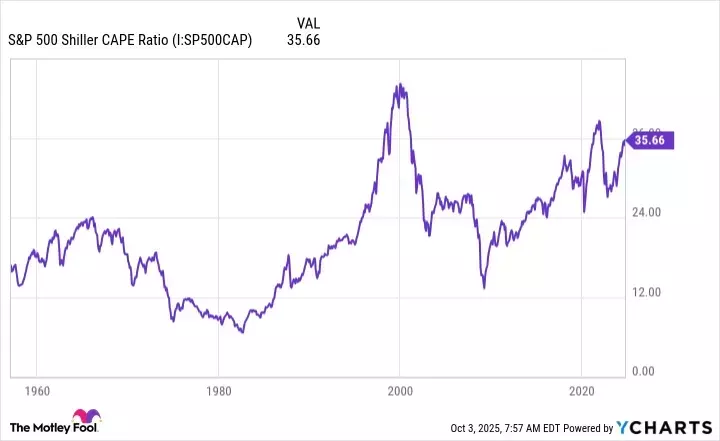
While the S&P 500's impressive rally is certainly welcome, it has concurrently led to elevated market valuations. The Shiller cyclically-adjusted price-to-earnings (CAPE) ratio for the S&P 500 has surpassed 35, a level reached only twice before in its 60-plus year history. This inflation-adjusted metric, which considers a decade of earnings per share, highlights a potential risk. Such high valuations could lead investors to perceive stocks as overpriced, potentially triggering a market correction if this sentiment becomes widespread. Consequently, this scenario could, in theory, contribute to a downturn in October.
October's True Track Record: A Statistical Review
A closer inspection of the S&P 500's performance over the past six Octobers reveals a balanced outcome, with an equal number of winning and losing months. Interestingly, the periods of decline have been relatively minor, while the positive months have exhibited considerable strength. This recent data suggests that the \"October effect\" might be more a matter of historical anecdote than a reliable predictor of contemporary market behavior. It underscores that market fluctuations are often tied to specific economic or systemic issues, rather than mere calendar dates, as exemplified by the 2008 financial crisis rooted in the subprime mortgage meltdown.
Strategic Investing: Beyond Seasonal Anxieties
For discerning investors, the persistent narrative surrounding the \"October effect\" should not be a primary driver of investment decisions. While some stocks may appear overvalued, a long-term perspective is crucial. Instead of succumbing to seasonal fears, investors are encouraged to conduct thorough due diligence, focusing on companies with robust fundamentals and promising long-term growth prospects. Moreover, any market decline, irrespective of when it occurs, can present a valuable opportunity for long-term investors to acquire quality assets at more attractive prices. Therefore, regardless of October's immediate market trajectory, it remains a critical period for strategic wealth accumulation.
