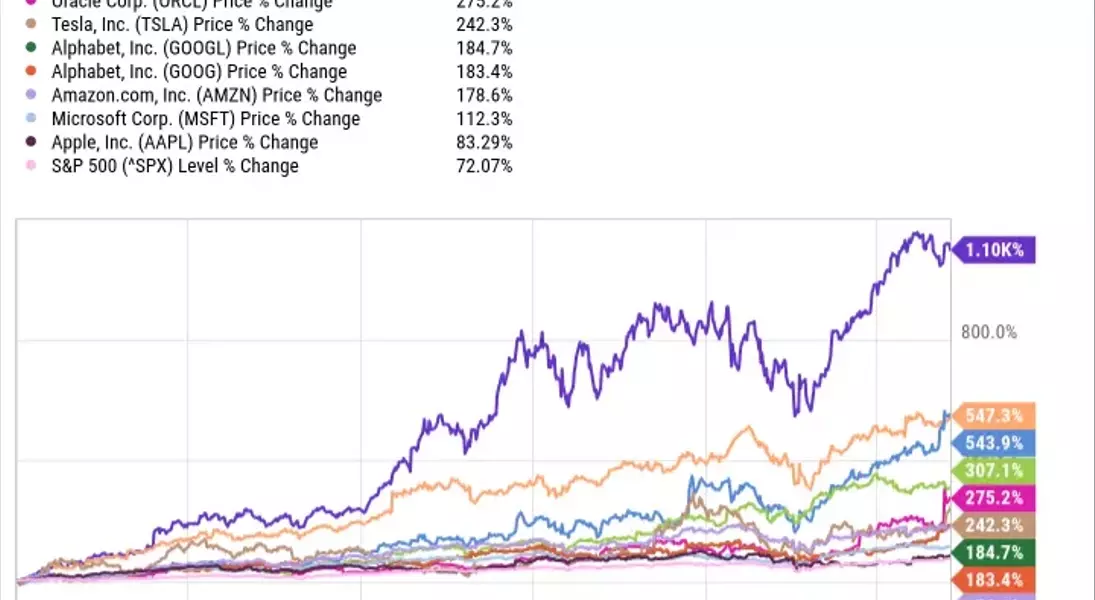

This analysis delves into the evolving landscape of the S&P 500, highlighting the disproportionate impact of a select group of mega-cap growth stocks, now referred to as the \"Ten Titans.\" It examines how these companies, particularly Broadcom and Oracle, have driven market performance and reshaped the index's composition, offering crucial insights for both active and passive investors.
Unpacking the Market's New Powerhouses: The \"Ten Titans\" Reshape the S&P 500
The Emergence of New Market Leaders Beyond the Conventional Giants
In 2025, technology and growth-oriented companies have significantly influenced market trends. Broadcom and Oracle have demonstrated exceptional performance, achieving substantial gains following their latest financial disclosures. Broadcom saw a 19% increase after its September 4 earnings report, while Oracle experienced a 36% surge on September 10, propelled by impressive earnings and optimistic forecasts. Both companies are rapidly approaching significant market valuations, with Broadcom nearing $2 trillion and Oracle nearing $1 trillion. Notably, these entities are distinct from the well-known \"Magnificent Seven,\" which comprises Nvidia, Microsoft, Apple, Amazon, Alphabet, Meta Platforms, and Tesla. To reflect this changing dynamic, the concept of the \"Ten Titans\" has emerged, incorporating Broadcom, Oracle, and Netflix alongside the original seven. This expanded group now constitutes a substantial 39.1% of the S&P 500.
The Transformative Impact of the \"Ten Titans\" on the Stock Market Structure
The collective influence of the \"Ten Titans\" has fundamentally altered the stock market over a short period. Since the beginning of 2023, the S&P 500 has experienced an impressive 70% increase, largely attributable to the boom in artificial intelligence (AI). This growth is concentrated in a few key players that benefit from AI advancements through semiconductors, networking infrastructure, cloud services, and efficiency innovations. The \"Ten Titans\" embody this trend, with their combined market capitalization now exceeding that of China's entire stock market. At the close of 2022, these companies represented 23.3% of the S&P 500. However, rapid appreciation, particularly from Nvidia and Broadcom, has propelled their cumulative weight to nearly 40%. This concentration signifies a departure from a balanced index, transforming the S&P 500 into a growth-centric benchmark where a handful of firms dictate overall performance. Consequently, investors seeking exposure to mid-cap or diverse large-cap opportunities might need to look beyond the traditional S&P 500 to achieve broad market diversification.
Strategic Considerations for Investors in a Titan-Dominated Environment
The ascendancy of the \"Ten Titans\" carries profound implications for investor portfolios, even for those not directly holding shares in these specific companies. Investors with holdings in market-capitalization-weighted index funds or exchange-traded funds (ETFs) that track the broader market or growth sectors are likely to have significant indirect exposure to these dominant firms. For instance, popular S&P 500 tracking funds, such as the Vanguard S&P 500 ETF, SPDR S&P 500 ETF, and iShares Core S&P 500 ETF, allocate approximately 39% of their assets to the \"Ten Titans.\" This heavy concentration suggests that while these funds offer exposure to top growth companies, they may also introduce increased market volatility due to the performance of a limited number of stocks. To mitigate this concentration risk, investors might consider diversifying into value or dividend-focused stocks, which now constitute a smaller portion of the S&P 500. Alternatively, for those seeking a straightforward and cost-effective way to invest in leading growth stocks, S&P 500 index funds continue to offer a viable pathway, albeit with the understanding of their inherent concentration.
