
This article explores the growing divergence between the robust stock market performance and the underlying fragilities in consumer financial health, highlighting the significant impact of elevated debt and housing costs on the broader economy.
Navigating Economic Contrasts: Market Peaks Amidst Consumer Strain
Understanding the Disconnect Between Market Performance and Consumer Well-being
Investors often perceive the stock market as a mirror reflecting the overall economy. However, this perspective may not fully capture the nuanced realities. While major indices like the S&P 500 continue to climb to unprecedented levels, a closer examination reveals considerable pressure on consumer spending. Industries reliant on direct consumer engagement, such as discretionary retail and hospitality, are experiencing notable downturns. For instance, earnings reports from prominent home improvement retailers indicate a sustained period of decline.
The Federal Reserve's Role and the Pace of Economic Recovery
Anticipated interest rate reductions by the Federal Reserve are poised to alleviate some of the financial burden on consumers, potentially stimulating spending. Nevertheless, it is crucial not to expect an immediate turnaround. A comprehensive understanding of the situation requires close attention to several key indicators related to household debt and the housing sector, especially given the stock market's current peak performance.
Consumer Financial Strain: Credit Card Debt and Mortgage Rates
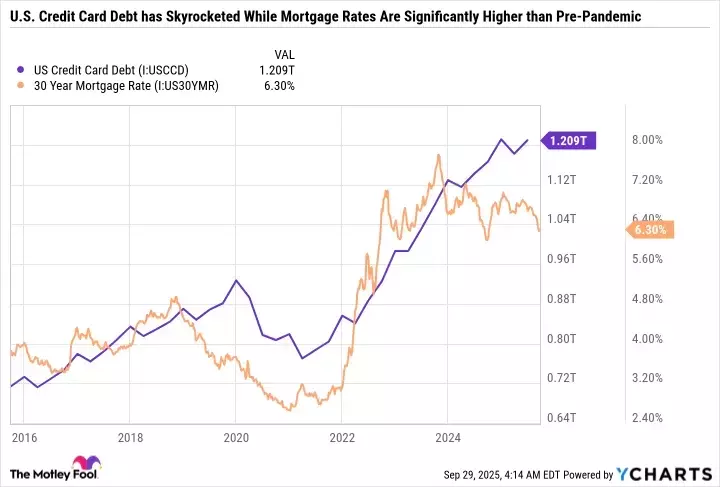
An analysis of historical data on U.S. credit card balances and 30-year mortgage rates over the past two decades illustrates a troubling trend. Leading up to the 2008 financial crisis, credit card debt saw a steady ascent. Post-crisis, both mortgage rates and debt levels temporarily receded. During the pandemic, credit card debt surged again, even as mortgage rates hit historic lows. These low borrowing costs, combined with government aid and increased savings, initially mitigated some of the financial pressures. However, recent years have witnessed an alarming rise in credit card debt alongside a significant escalation in mortgage interest rates.
Evaluating Household Financial Health: A Corporate Analogy
The financial well-being of American households can be likened to assessing a corporate entity. High levels of debt, much like a leveraged balance sheet, restrict discretionary spending. Concurrently, elevated mortgage rates render homeownership increasingly unattainable for many. Various economic metrics strongly suggest that the housing market is bracing for an extended period of unaffordability.
The Unaffordability Crisis in American Housing
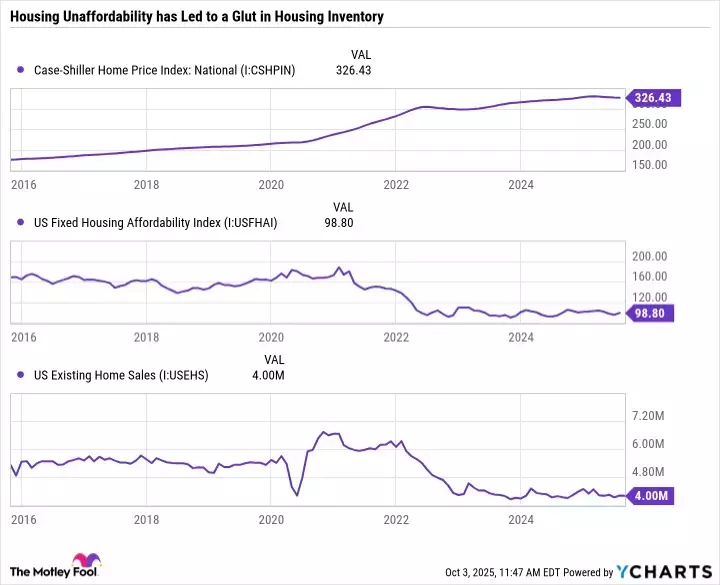
Examining ten-year trends across critical housing market indicators paints a stark picture. The Case-Shiller Housing Index, often considered the S&P 500 equivalent for the housing sector, indicates that home prices are exceptionally high. Yet, this only reveals part of the story. The more critical metric is housing affordability, which factors in both home prices and mortgage rates. The U.S. fixed housing affordability index provides a clear perspective: a score of 100 signifies that a household with the median income possesses sufficient funds to qualify for a mortgage on a median-priced home, assuming a 20% down payment. A score above 100 suggests more than adequate income for qualification. Currently, the index hovers around 98, implying that, on average, a median-income family struggles to secure a home loan under these conditions. Consequently, sales of existing homes have sharply declined, indicating widespread difficulties in selling properties at their market valuations.
Stock Market Resilience Amidst Consumer Weakness
The overarching conclusion from these debt and housing statistics is that a substantial portion of consumers are burdened by escalating credit card balances and face insurmountable barriers to homeownership. Even with sustained interest rate cuts from the Federal Reserve, these systemic issues are unlikely to dissipate quickly. Many consumers may opt to defer significant purchases, including homes, and prioritize debt reduction and savings accumulation.
The Paradox of a Strong Job Market and Limited Consumer Capacity
A resilient job market, characterized by a low unemployment rate, has served as a critical buffer. While many individuals are employed, their earnings often fall short of enabling them to afford housing or non-essential goods. This disparity compels them to incur more debt and postpone homeownership. These dynamics profoundly impact companies catering directly to consumers. Although many restaurant and retail stocks may appear undervalued, their struggles are rooted in legitimate economic challenges. This presents a unique opportunity to invest in robust, high-quality consumer discretionary businesses built for long-term endurance. However, the prevailing debt and housing metrics underscore a significant bifurcation within the stock market: a growing divide between the financial strength of corporations and the precarious state of consumer finances. Business-to-business enterprises, particularly those benefiting from increased artificial intelligence expenditures, are poised for continued growth in earnings and stock valuations. Yet, these gains may not meaningfully benefit a large segment of the American populace not actively participating in the market. Ultimately, these critical debt and housing indicators demand serious consideration and raise legitimate concerns regarding their pervasive influence on the consumer economy, even if their direct impact on the overall stock market appears somewhat contained for now.
