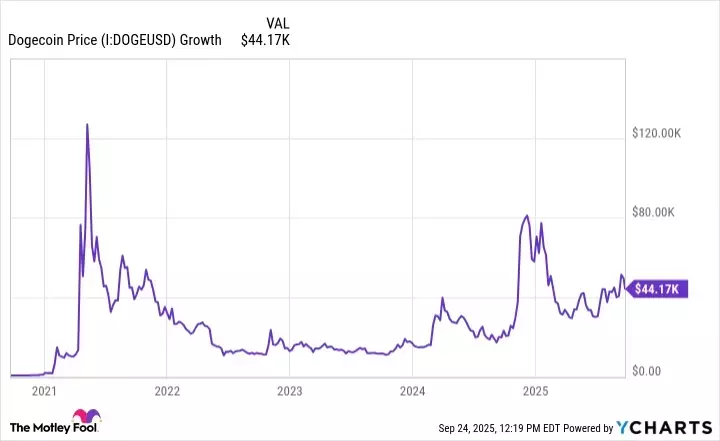

Dogecoin, conceived initially as a humorous critique of the cryptocurrency landscape, has defied expectations by evolving into a major player in the digital asset market. Despite its origins as a joke and its lack of intrinsic utility compared to counterparts like Bitcoin, its journey over the past five years illustrates the potent influence of viral trends and community engagement in the financial world.
Dogecoin's Remarkable Journey: From Joke to Crypto Giant
In late 2013, Dogecoin emerged onto the scene, branded with the iconic Shiba Inu mascot, as a satirical commentary on the burgeoning cryptocurrency craze. What began as a lighthearted jest unexpectedly burgeoned into a formidable force, captivating a massive online community. By September 24th, its market capitalization soared beyond $37 billion, securing its position as the eighth-largest cryptocurrency worldwide. This remarkable ascent is particularly striking given its inherent characteristics: unlike Bitcoin, which boasts a finite supply of 21 million tokens and is widely considered a digital store of value, Dogecoin's supply expands by 5 billion tokens annually, a design choice that undermines its scarcity. Furthermore, its technical infrastructure is relatively rudimentary, supporting limited transactions per second and lacking the sophisticated smart contract capabilities found in more advanced blockchain networks. While there are discussions and efforts, notably by MyDoge, to develop a layer-2 solution to enhance its functionality, the realization and impact of such developments remain uncertain. Nevertheless, Dogecoin's enduring appeal highlights a unique aspect of the crypto market where community enthusiasm and viral momentum can significantly outweigh traditional financial metrics.
Dogecoin's trajectory offers a compelling case study on the interplay of technology, community, and market sentiment. Its unexpected success underscores that investment value is not solely predicated on fundamental utility or technical sophistication, but can also be driven by cultural phenomena and collective belief. This phenomenon challenges conventional investment wisdom, prompting observers to consider the evolving dynamics of digital assets and the profound impact of social media on market valuation.
