
This analysis delves into the investment landscape of midstream energy companies, focusing on Energy Transfer and its notable 7.5% dividend yield. It critically evaluates whether this high yield alone makes Energy Transfer a superior investment compared to its peers. The discussion highlights the importance of dividend reliability and a forward-thinking approach to clean energy in making sound investment decisions, ultimately suggesting that while Energy Transfer isn't a poor choice, alternative investments may offer more stability and growth potential.
Re-evaluating High Yield: A Comparative Analysis of Midstream Energy Investments
On September 21, 2025, a detailed investment report shed light on the midstream energy sector, specifically examining the allure of Energy Transfer's substantial 7.5% yield. The report, authored by Reuben Gregg Brewer, aimed to guide investors beyond the immediate appeal of high dividends by comparing Energy Transfer with two prominent competitors: Enterprise Products Partners and Enbridge. The S&P 500 index's meager 1.2% yield and the average energy company's 3.2% yield were cited as benchmarks, making Energy Transfer's offering seem exceptionally attractive at first glance.
Energy Transfer, a master limited partnership (MLP), operates a vast network of crucial energy infrastructure, utilizing a 'toll-taker' business model for its pipelines and storage facilities. This model positions it within the midstream segment, known for its stability within the broader, often volatile, commodity-driven energy sector. However, the report raised a critical point regarding trust, particularly for income-seeking investors who prioritize consistent and growing dividends.
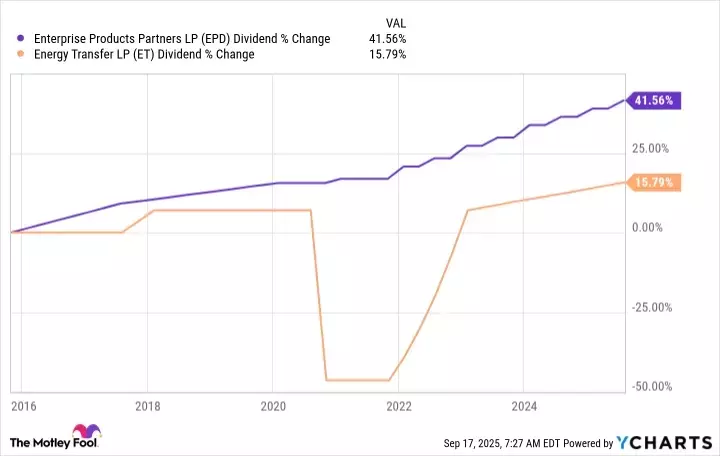
A key finding was Energy Transfer's decision to cut its distribution in 2020 amidst the COVID-19 pandemic. While the company's distributions have since recovered and even surpassed pre-cut levels, this event serves as a cautionary tale for investors seeking unwavering income. In contrast, Enterprise Products Partners, another MLP, has demonstrated remarkable dividend consistency, increasing its distributions annually for 27 consecutive years, providing a stark contrast in terms of reliability.
Furthermore, the energy industry is in a transitional phase, moving towards cleaner energy sources. While Energy Transfer acknowledges this shift by focusing on oil and natural gas, Enbridge, a Canadian counterpart, is actively integrating cleaner energy options into its portfolio. Enbridge boasts a 5.6% dividend yield and an impressive three-decade record of annual dividend increases (in Canadian dollars). Its strategic acquisitions, including regulated natural gas utilities and investments in renewable power assets like offshore wind farms, position it as a forward-looking entity in the evolving energy landscape.
Ultimately, the report suggests that while investing in Energy Transfer might not be a mistake, it may not be the most sagacious choice for certain investor profiles. Conservative investors valuing dividend reliability might find Enterprise Products Partners a more reassuring option, despite its slightly lower 6.8% yield. For those looking to hedge against future energy transitions and prioritize a cleaner energy footprint, Enbridge, with its even more reliable dividend history and strategic shift towards renewables, emerges as a brighter prospect, even with a 5.6% yield.
Reflections on Yield, Reliability, and Future-Proofing Investments
This detailed comparison of midstream energy companies offers a profound lesson for all investors: a high yield alone does not guarantee a smart investment. It underscores the critical importance of examining a company's dividend history, its operational resilience during challenging times, and its strategic alignment with future industry trends. For income investors, the security and predictability of distributions often outweigh the sheer size of the yield. The case of Energy Transfer highlights that past performance, especially during crises, is a strong indicator of future reliability. Moreover, as global industries pivot towards sustainability, companies actively integrating cleaner practices, like Enbridge, may offer more sustainable long-term growth and stability. This reminds us to look beyond immediate returns and consider the broader economic and environmental shifts that will shape future market leaders.
