
Understanding that investing can seem daunting, this guide simplifies the process by focusing on Exchange-Traded Funds (ETFs). These financial instruments enable investors to hold stakes in numerous companies concurrently, offering an efficient path to instant diversification. Such an approach is particularly advantageous when market conditions are unpredictable, or when valuations of prominent companies appear inflated. The following discussion delves into two specific ETFs that can strategically enhance an investment portfolio, each serving a unique, complementary function.
This article explores the strategic advantages of incorporating specific ETFs into an investment portfolio, especially during periods of market volatility or when seeking diversification beyond domestic markets. It emphasizes how ETFs simplify investing by providing exposure to multiple assets through a single investment, thereby offering instant diversification and meeting various investment objectives. The focus is on two distinct ETFs: one that prioritizes high-quality dividend-paying companies for stable income and another that offers broad international market exposure to mitigate risks and capture global growth opportunities. These selections are presented as effective tools for investors aiming to construct a resilient and well-rounded portfolio.
The Appeal of Dividend-Focused ETFs for Stable Returns
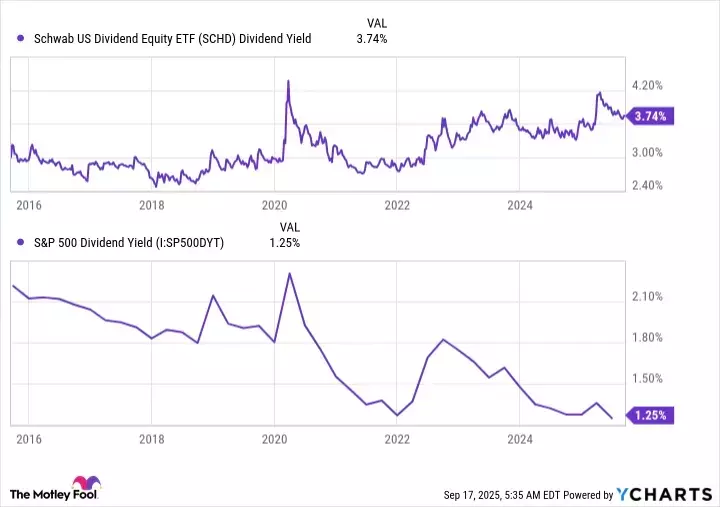
The Schwab U.S. Dividend Equity ETF (SCHD) stands out as a reliable choice for investors prioritizing consistent income. This ETF meticulously tracks the Dow Jones U.S. Dividend 100 Index, which mandates that constituent companies demonstrate robust financial health, including steady cash flow, a solid balance sheet, and a proven track record of at least a decade of dividend distributions. This stringent selection criterion ensures that SCHD comprises high-caliber companies, aligning perfectly with a long-term investment philosophy. With a dividend yield surpassing 3.7%, significantly higher than the S&P 500's average, SCHD offers an attractive income stream. Moreover, the fund has shown impressive dividend growth, increasing its payout by over 160% in the last ten years. This growth not only amplifies returns through reinvestment but also acts as a financial buffer during market downturns, helping to stabilize portfolio performance.
Investing in dividend-paying ETFs like the Schwab U.S. Dividend Equity ETF (SCHD) offers a compelling strategy for long-term portfolio stability and growth. Unlike individual stocks where dividend payouts can be more volatile, SCHD's structure, which tracks the Dow Jones U.S. Dividend 100 Index, ensures that it includes only companies with strong fundamentals, such as consistent cash flow and a history of at least ten years of dividend payments. This focus on high-quality, reliable dividend payers provides investors with a predictable income stream and a measure of security, particularly during uncertain market periods. The ETF's dividend yield, currently above 3.7%, not only outpaces the S&P 500's average but also demonstrates a significant growth trajectory, with payouts increasing by more than 160% over the past decade. This consistent and growing dividend stream is crucial for harnessing the power of compounding, as reinvested dividends acquire more shares, further accelerating wealth accumulation. Furthermore, the steady income from dividends can cushion potential losses when the market experiences a decline, making SCHD a robust component for any diversified investment portfolio.
Expanding Horizons: Diversifying with International Market Exposure
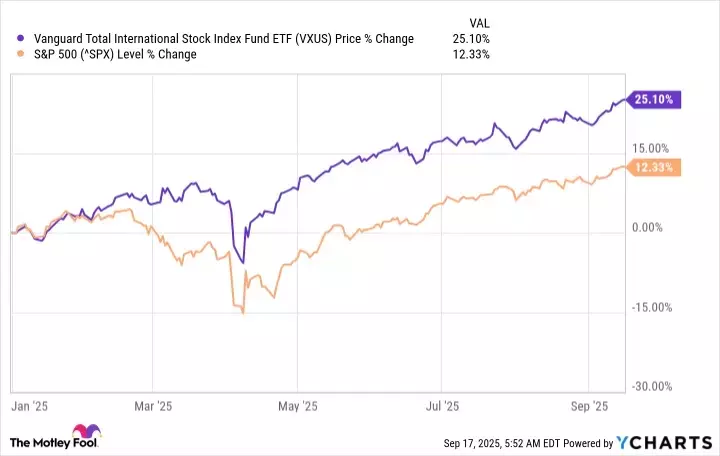
Diversification is a cornerstone of prudent investing, and extending this principle to global markets is crucial. The Vanguard Total International Stock ETF (VXUS) offers an excellent solution for achieving this broader geographical exposure. Unlike many international ETFs that concentrate on specific countries or regions, VXUS provides access to a vast array of companies across nearly all non-U.S. developed and emerging markets. This comprehensive coverage offers a dual advantage: the relative stability often associated with investments in developed economies, coupled with the significant growth potential found in emerging markets. While VXUS has historically lagged the S&P 500 due to the dominance of U.S. tech giants, it has shown superior performance this year, nearly doubling the S&P 500's returns. Given the S&P 500's current high valuation, VXUS can act as a strategic hedge against potential pullbacks in the American market. A common recommendation for investors is to allocate approximately 10% of their portfolio to international stocks, with VXUS providing a highly effective means to meet this target.
To truly achieve comprehensive portfolio diversification, it's essential to look beyond domestic markets and integrate international exposure. The Vanguard Total International Stock ETF (VXUS) is specifically designed to meet this need by providing investors with a broad and inclusive stake in companies from virtually every corner of the non-U.S. world. This ETF's strength lies in its wide-ranging inclusion of both developed and emerging markets, offering a balanced approach to global investing. This strategy allows investors to benefit from the established economic stability of developed nations while also tapping into the dynamic growth prospects of emerging economies. Although VXUS's performance has historically trailed the S&P 500 due to the robust growth of large-cap U.S. technology companies, it has recently demonstrated impressive resilience and outperformance, significantly exceeding the S&P 500's returns in the current year. This recent trend underscores VXUS's potential as a valuable counter-balance in a portfolio, especially when the U.S. market is experiencing historically high valuations, offering a protective hedge against possible market corrections. For many investors, allocating around 10% of their total investment portfolio to international stocks through an ETF like VXUS is a judicious strategy for enhancing diversification and fostering long-term growth.
