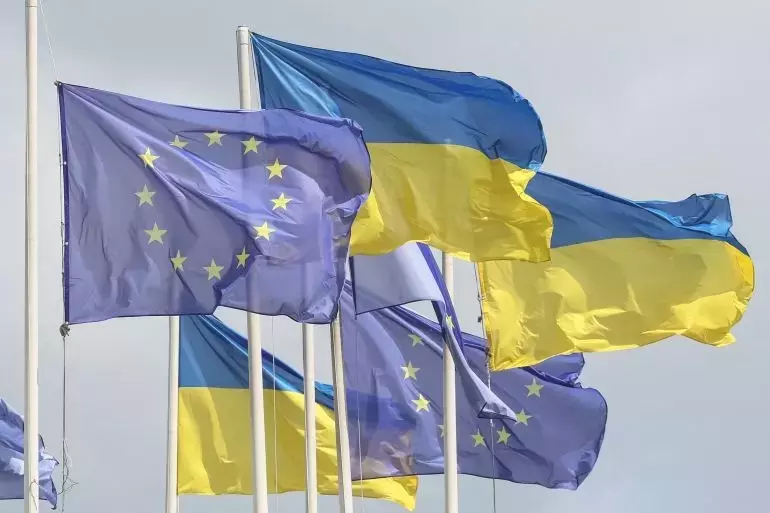
The European Union has officially commenced the accession process for Ukraine and Moldova, marking a pivotal moment for both nations. This formal launch on a recent Monday necessitates years of profound political and structural reforms. For Ukraine, this intricate journey unfolds as it continues to grapple with the Russian invasion, seeing EU membership as a vital safeguard and a cornerstone for its alignment with Western values. Moldova also embarks on this path, having demonstrated its commitment to pro-Western policies.
Ukraine's Deputy Prime Minister, Taras Kachka, participated in an intergovernmental conference in Luxembourg, signaling the start of discussions aimed at harmonizing Kyiv’s legal and institutional frameworks with the EU’s 27-member bloc. Kachka emphasized the urgency and comprehensive nature of this accession, stating that persistent aggression from Russia necessitates unity and accelerated integration into the European Union.
Despite the enthusiasm, concerns linger within the EU regarding Ukraine’s readiness, particularly concerning the security implications of its ongoing conflict with Russia and Moscow’s annexation of certain regions. While NATO membership is considered Ukraine’s optimal security guarantee, geopolitical complexities, including the stance of the former Trump administration and reservations from other member states during the ongoing conflict, have presented challenges.
Hungary, under its former Prime Minister Viktor Orban, previously hindered Ukraine’s accession due to his regime’s close ties with Russia. However, following Orban’s electoral defeat in April, his successor, Péter Magyar, has pursued a re-engagement with the EU mainstream. This shift led to Hungary lifting its veto on Ukraine’s membership bid, a decision that coincided with the unblocking of over €16 billion in frozen EU funds for Budapest. Concurrently, Moldova has been actively countering Russian attempts to maintain its influence, successfully navigating a disinformation campaign, reportedly fueled by artificial intelligence, during its recent elections, which saw the re-election of its pro-Western incumbent.
Prospective EU member states must complete negotiations across 35 policy areas, or “chapters,” encompassing diverse sectors such as agriculture, taxation, energy, and trade. This process typically extends over many years. The initial meeting focused on five crucial “clusters” that form the bedrock of the bloc’s principles: the rule of law, fundamental rights, and the efficacy of democratic institutions. These chapters include judiciary and fundamental rights, justice, freedom and security, public procurement, and statistics and financial control. This focus is particularly significant for some EU countries that have expressed reservations about Ukraine’s capacity and resolve to combat corruption.
Kaja Kallas, the EU’s foreign policy chief, lauded the commencement of this process as a “major milestone,” commending both Ukraine and Moldova for their successful and challenging reforms under extraordinary circumstances. She affirmed that their eventual membership would undoubtedly strengthen Europe. Some European nations advocate for a swift integration of Ukraine into the bloc, believing it is indispensable for Europe’s security and crucial for bolstering its armed forces. German Chancellor Friedrich Merz, for instance, proposed “associate membership” for Ukraine to reinvigorate peace talks with Russia. Other countries, such as France and the Netherlands, have suggested alternative pathways for quicker integration without immediately granting full membership rights. Nevertheless, EU officials and other aspiring member states maintain that the accession process must remain merit-based, ultimately leading to nothing less than full membership.
This initiative represents a significant commitment from both the EU and the applicant countries, signaling a shared vision for a more integrated and secure European future. The path ahead is demanding, requiring sustained dedication to reform and alignment with EU standards, but the mutual benefits of this expansion are anticipated to be substantial, reinforcing stability and shared prosperity across the continent.
