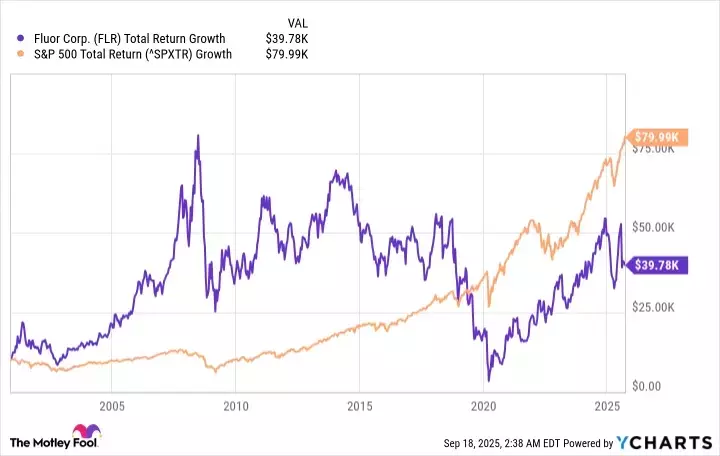

Fluor Corporation, a prominent engineering and construction company, has seen considerable fluctuations in its stock value during 2025. After an initial drop from $55 to $30 at the beginning of the year, the stock rebounded sharply to $55, only to decline again to $40. While some financial analysts view the current price as an opportune moment for investment, a broader look at the company's historical performance reveals a more complex picture. Founded in 1912, Fluor has been a key player in major infrastructure projects, including pipelines, refineries, and nuclear facilities. However, its involvement in these cyclical industries means that its financial performance is heavily influenced by economic boom and bust periods, leading to considerable volatility in its stock price and, over the long term, underperformance compared to the broader market.
The current year's significant price swings highlight the inherent instability that has characterized Fluor's stock. The early 2025 period saw a steep decline, which was quickly followed by a strong recovery, only to be succeeded by another downturn. This rapid up-and-down movement underscores the unpredictable nature of investing in companies deeply tied to industries known for their sensitivity to economic cycles. This volatility often leads to short-term speculative interest, yet long-term investors need to consider the company's fundamental business model and its exposure to these fluctuating markets.
Fluor's long history dates back to 1912 when it started as a small construction enterprise in California. Over the decades, it expanded its operations to encompass large-scale infrastructure projects across various sectors. These sectors, including energy, mining, and heavy construction, are inherently cyclical. This means that periods of high demand and profitability are often followed by contractions, leading to revenue and project backlogs that fluctuate dramatically. For instance, strong commodity prices in 2007 led to increased business for Fluor, but the subsequent global financial crisis in 2008 caused a significant downturn, illustrating how external economic factors directly impact the company's financial health.
An analysis of Fluor's stock performance since 2000, particularly with dividends reinvested, shows that a $10,000 investment would have grown to approximately $39,780. In contrast, the same amount invested in the S&P 500 would have yielded around $79,980. This significant disparity indicates that Fluor has consistently underperformed the broader market over the past two decades. Although the stock has demonstrated impressive growth, climbing over 300% since 2020, this recent surge does not negate the long-term trend of underperformance. The company's reliance on cyclical markets means that investors should anticipate ongoing periods of significant price fluctuations and should not necessarily expect superior long-term returns compared to diversified market investments.
Ultimately, while Fluor Corporation has shown strong short-term gains and continues to be a major player in its field, its long-term stock performance is largely shaped by the cyclical patterns of the industries it serves. This consistent exposure to boom and bust cycles suggests that while the company may experience periods of rapid growth, it also faces inherent risks that can lead to prolonged periods of underperformance relative to the broader market. Investors considering Fluor must therefore adopt a cautious perspective, understanding that the company's stock is highly susceptible to macro-economic shifts and industry-specific trends.
