Ford Motor Company is currently grappling with a substantial and escalating issue concerning vehicle quality, as evidenced by an unprecedented number of recalls in 2025. This situation has led to increasing warranty costs, directly impacting the automaker's financial performance and raising questions among investors about the effectiveness of its quality improvement initiatives. The challenges are not merely isolated incidents but point towards a more systemic problem within the company's production and design processes.
The automotive giant recently announced a massive recall of 1.9 million vehicles worldwide, with approximately 1.45 million of these in the United States. The primary cause for this particular recall is a widespread malfunction in the rearview camera systems, which can result in inverted, distorted, or completely blank images. Affected models span various vehicle lines, including popular models like the Lincoln MKC and Navigator, Ford Mustang, F-Series trucks (F-250, F-350, F-450, F-550), Expedition, and Edge. This extensive list of affected vehicles underscores the broad scope of the issue.
The implications of this recall are significant because, unlike some modern vehicle issues that can be resolved through over-the-air software updates, many of Ford's 2025 recalls necessitate physical inspections and repairs at dealerships. This translates to higher costs and greater inconvenience for both the company and its customers. The sheer volume of recalls this year for Ford is particularly striking; the company has issued 109 recalls in the U.S. alone, far surpassing competitors such as Stellantis, which has recorded only 30 recalls. This trend suggests that Ford could potentially recall over 10 million vehicles by year-end, a figure that would more than double its global sales from the previous year.
A critical historical context to this situation is a civil penalty of $165 million that Ford was forced to pay in November of the previous year. This penalty was imposed by the National Highway Traffic Safety Administration (NHTSA) following an investigation that found Ford had been tardy in recalling vehicles with faulty rearview cameras. The current recall, also related to rearview camera issues, echoes this past transgression and indicates a persistent problem that the company has struggled to resolve effectively.
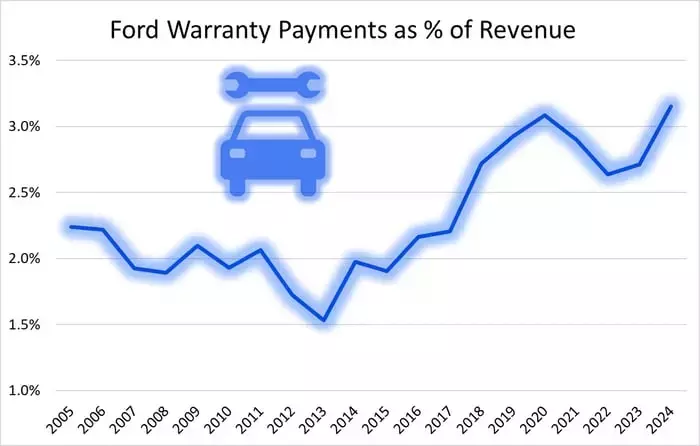
Investors are increasingly concerned about these developments, as the company's stated commitment to improving quality under CEO Jim Farley has yet to translate into a reduction in warranty claims costs. Instead, financial data reveals a worrying trend: Ford's warranty costs as a percentage of its revenue have been steadily climbing over several years. This rise suggests that despite efforts to enhance quality, the underlying issues leading to these costs have not been adequately addressed. Furthermore, the diverse nature of the recalls in 2025—covering electronic, mechanical, and even less critical trim issues—indicates that the problem is not confined to a single component or vehicle line but rather reflects a broader deficiency in the company's quality control or manufacturing processes, distinguishing it from isolated incidents like General Motors' past ignition switch recall.
While some argue that an increased focus on quality might paradoxically lead to more recalls as more defects are identified, the current situation at Ford signals a more profound challenge. The continued surge in recalls and associated warranty expenses in 2025 points to a significant crisis in product quality. For long-term investors, while Ford offers an attractive dividend yield and a robust balance sheet, the company's ability to fundamentally address and rectify these persistent quality concerns and subsequently lower its warranty costs will be crucial for its future success and investor confidence.
