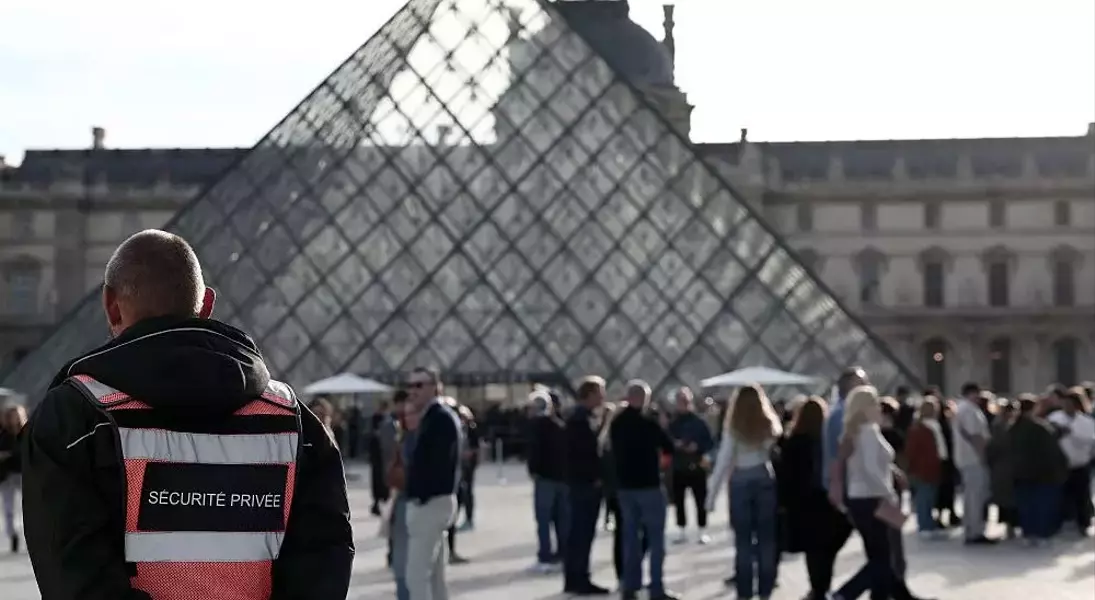
A recent breakthrough in the investigation into the high-profile theft of French crown jewels from the Louvre Museum has led to the apprehension of a fourth suspect. This individual, taken into custody in Laval, France, is believed to be a key player in the operation that saw precious artifacts vanish from the renowned Parisian institution. The incident has not only highlighted vulnerabilities in the museum's security protocols but also prompted an extensive manhunt and a thorough reevaluation of its protective measures.
On Tuesday, law enforcement officials confirmed the arrest of four additional individuals linked to the brazen daylight robbery that occurred last month at the Louvre. Among them is a man, now in police custody, who is thought to be the fourth member of the primary group responsible for orchestrating the heist. The arrest took place in Laval, a city located approximately 174 miles west of the French capital.
Reports from Le Parisien indicate that the recently arrested suspect possesses a prior criminal record and faces charges including organized theft and criminal conspiracy. Investigators also suspect that this individual maintained connections with the three other alleged perpetrators who were previously detained in connection with the same incident.
Furthermore, three relatives of one of the suspects were brought in for questioning, as confirmed by Paris prosecutor Laure Beccuau. These individuals, two men aged 38 and 39, and two women aged 31 and 40, all reside in the Paris region. The identities of the three men and one woman previously charged in the case were revealed in media reports as Ayed G, Slimane K, and Abdoulaye N. Among them are a taxi driver and a delivery man/garbage collector; the latter was intercepted at Paris’s Charles de Gaulle Airport while allegedly attempting to flee to Algeria on a one-way flight. The remaining two are a couple with two children; the woman was subsequently released from custody and placed under judicial supervision.
The prosecutor, Beccuau, previously remarked to France Info Radio that while the crime was not typical everyday delinquency, it also did not appear to be characteristic of high-level organized crime. The thieves are reportedly from Seine-Saint-Denis, a suburb of Paris.
The heist itself, which occurred on Sunday, October 19, around 9:30 a.m., involved the use of a cherry picker and an angle grinder to breach the Louvre’s Apollo Gallery. In less than eight minutes, the robbers made off with nine pieces of jewelry, valued at an estimated $102 million. CCTV footage captured the culprits descending from a gallery window before making their escape on scooters. One of the stolen items, a crown once belonging to Empress Eugénie, has since been recovered outside the museum and is slated for conservation.
During a hearing with the French senate, Louvre director Laurence des Cars acknowledged that alarms did sound during the robbery, but she conceded that the museum’s security systems were “very inadequate” and “outdated.” While the Louvre has initiated a series of emergency security enhancements, the full scope of recommended upgrades, based on a French national audit, is not anticipated to be completed until 2032. Nevertheless, plans are in motion to install approximately 100 surveillance cameras and anti-intrusion systems as part of these heightened security measures.
The search for the remaining stolen jewels continues, with the items listed in Interpol’s Stolen Works of Art database. In response to the theft, the Louvre has taken the precautionary step of transferring its most invaluable jewels to the Bank of France for enhanced safekeeping, underscoring the ongoing efforts to protect its irreplaceable collection.
