
This article explores the potential for the U.S. government to invest in defense companies, with a specific focus on Lockheed Martin, following a similar move with Intel. It examines the implications of such an investment for the company's growth, financial stability, and market valuation, while also considering the broader context of government spending and its impact on the defense sector.
Unlocking Value: The Government's Eye on Defense Giants
Government's Expanding Investment Horizon Beyond Intel
Following its recent acquisition of a 10% interest in the computer chip manufacturer Intel, sourced from pre-allocated grants including those under the CHIPS and Science Act, the U.S. government has indicated a readiness to explore further corporate investments. This suggests that the Intel transaction was not an isolated incident, and other companies might soon experience similar governmental backing. Such state involvement can offer significant corporate stability and open new avenues for expansion, though it may also entail heightened regulatory scrutiny.
Lockheed Martin: A Prime Candidate for Government Partnership
Given the government's expressed interest in expanding its corporate portfolio, aerospace and defense giant Lockheed Martin emerges as a prominent candidate for potential investment. As a leading manufacturer of advanced military aircraft, such as the F-35 fighter jet, Lockheed Martin is integral to national defense strategies. A substantial portion of its revenue, approximately 73% or $13.1 billion from its latest quarter's $18.2 billion total, is generated through contracts with the U.S. government. This deep-seated relationship positions Lockheed Martin favorably for future government partnerships.
Strategic Rationale Behind Potential Government Stake in Lockheed Martin
The close ties between Lockheed Martin and the U.S. government have led to speculation about a potential government stake. Commerce Secretary Howard Lutnick has openly acknowledged extensive discussions regarding defense investments, even describing Lockheed Martin as "essentially an extension of the U.S. government." Although no official announcements have been made, it is evident that Lockheed Martin is among several defense enterprises being considered for government investment.
Evaluating Lockheed Martin's Growth Prospects and Market Position
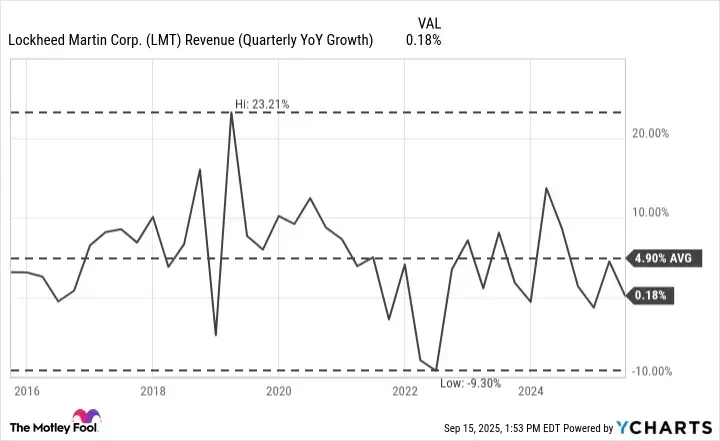
While Lockheed Martin maintains a robust and profitable operational foundation, its recent growth performance has been modest, with stagnant sales in the last quarter reflecting a historically slow-growth business model. However, an acceleration in its growth rate was observed during the initial term of President Trump, beginning in 2017. Historically, Republican administrations have demonstrated a propensity for increased defense spending, and a continuation of this trend could significantly boost Lockheed Martin's appeal to investors.
Investment Considerations for Lockheed Martin Stock
Despite a roughly 3% decline this year and a 17% drop over the past 12 months, Lockheed Martin stock presents an intriguing opportunity. Trading at a forward price-to-earnings multiple of 16, it appears undervalued compared to the S&P 500's multiple exceeding 21. The company also offers an attractive dividend yield of 2.8%, providing an additional incentive for long-term investors. The decision to invest in Lockheed Martin should primarily rest on its fundamental strengths, rather than solely on the prospect of government intervention, as governmental policies are subject to change. With consistent profitability and solid earnings, Lockheed Martin stands as a reliable long-term investment, even if it is not categorized as a high-growth stock, particularly for those seeking steady dividend income.
