
International Business Machines (IBM) has undergone a notable transformation, shedding its image as a slow-growth legacy technology company to re-emerge as a formidable leader in the cutting-edge fields of artificial intelligence (AI) and quantum computing. This strategic pivot, underscored by key acquisitions and sustained innovation, has not only revitalized its financial performance but also positioned it as an attractive investment. With a robust dividend yield and a forward-looking valuation, IBM's journey from past challenges to present triumphs offers a compelling narrative for investors seeking opportunities in the evolving tech landscape.
IBM's Strategic Revival: A Detailed Report on Its AI, Cloud, and Quantum Computing Dominance
In a significant development, IBM, the venerable technology giant, has successfully recalibrated its corporate strategy to become a frontrunner in the fiercely competitive domains of artificial intelligence and quantum computing. This turnaround began in 2019 when Arvind Krishna, then a division head, orchestrated the pivotal $34 billion acquisition of Red Hat. This strategic move instantly propelled IBM into a leading position within the cloud computing sector, particularly in hybrid cloud solutions, which are now indispensable for AI model training and global deployment. Krishna's vision led to his appointment as CEO in 2020, solidifying the company's commitment to this new direction.
IBM's AI capabilities are primarily channeled through its watsonx platform, which provides essential tools for customers to develop, validate, refine, and deploy AI models. This platform leverages the enhanced cloud infrastructure gained from the Red Hat acquisition, providing the necessary computational power and data storage. Furthermore, IBM is making substantial strides in quantum computing, a technology poised to revolutionize computational power by processing data beyond traditional binary limits. IBM currently boasts the world's largest fleet of quantum computers and aims to release a "fault-tolerant" quantum computer by 2029. This advancement is crucial for overcoming the high error rates inherent in current quantum systems, potentially granting IBM a significant competitive edge in this nascent yet promising field.
Financially, IBM's strategic shift is yielding tangible results. Despite the 2021 spin-off of Kyndryl, which streamlined its operations, the company reported revenue growth of 4% in the first half of 2025, reaching nearly $32 billion, with an impressive 8% year-over-year increase in the second quarter alone. Operating income also saw a 14% annual rise during the first two quarters. Although net income experienced a 5% decline due to elevated income tax expenses, IBM forecasts a free cash flow of $13.5 billion for the year, an increase from $12.7 billion in the previous year. This substantial cash flow comfortably covers its $6.2 billion in dividend costs, supporting a dividend that has consistently increased for 30 consecutive years, now standing at $6.72 per share annually. The current dividend yield of 2.4% is approximately double the S&P 500 average, making it particularly attractive to income-focused investors.
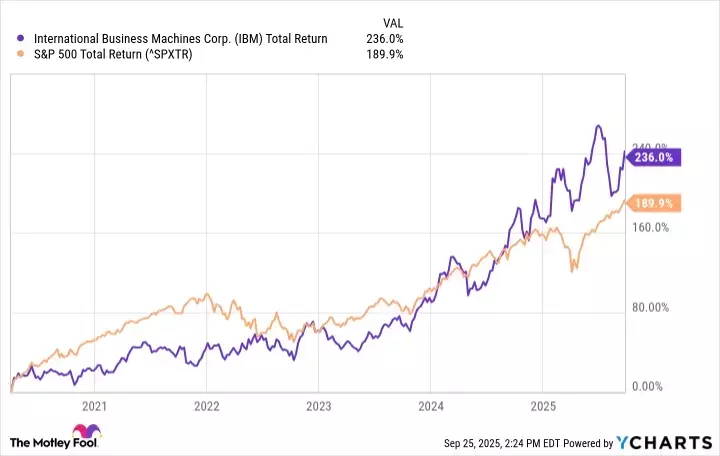
Under Krishna's leadership, IBM's stock has achieved new record highs, outperforming the S&P 500 in total returns since April 2020. While its P/E ratio has climbed to 45, significantly higher than the 10 P/E ratio when Krishna took office, its forward P/E ratio of 25 still suggests a reasonable valuation. This, coupled with renewed growth prospects and technological leadership, makes IBM an intriguing investment option even after its recent market gains.
The transformation of IBM stands as a powerful testament to the impact of strategic foresight and adaptive leadership in the technology sector. Its successful pivot into AI and quantum computing, combined with a strong financial profile and attractive dividend, illustrates that even established companies can innovate and thrive by embracing emerging technologies. For investors, this narrative underscores the importance of looking beyond immediate market trends to identify companies with the capacity for reinvention and sustainable growth in the long term.
