
Despite the recent surge in artificial intelligence stocks, not all opportunities are created equal. This analysis highlights why certain companies, particularly those involved in AI hardware and established technology, present more compelling investment prospects than others, such as Palantir, which may currently be overvalued. The burgeoning demand for AI necessitates a robust underlying infrastructure, making hardware providers and innovative chip manufacturers pivotal players in this evolving landscape.
As the AI sector continues its rapid expansion, investors are advised to scrutinize valuations closely. While some companies have experienced extraordinary stock gains, these increases do not always reflect proportional business growth. Focusing on firms that underpin the AI revolution, through providing essential hardware or leading AI development with sustainable financial metrics, offers a more prudent investment strategy in this dynamic market.
The Discrepancy Between Palantir's Stock Performance and Business Growth
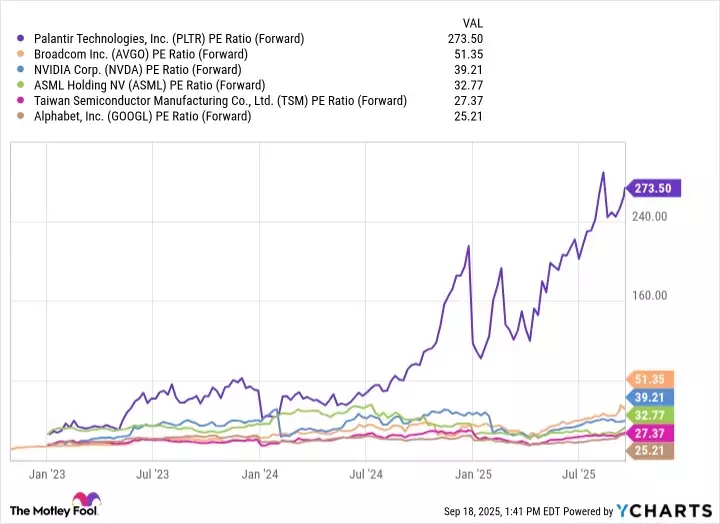
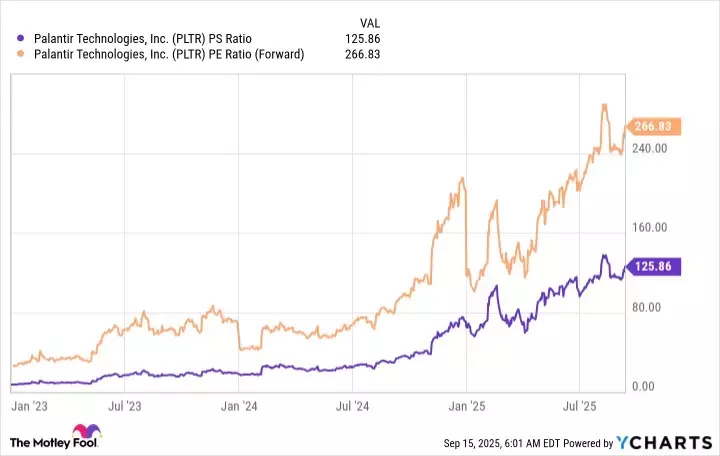
Palantir Technologies has recently experienced a significant surge in its stock value, outperforming even industry giants like Nvidia over the past few years. However, this impressive stock appreciation, which saw its shares rise by 2,570% since early 2023, largely outstrips its actual revenue growth of only 81% during the same period. This notable disparity suggests that a substantial portion of Palantir's stock performance is attributable to an expansion in its valuation multiples rather than fundamental business growth. With a price-to-sales ratio of 126 times and a forward earnings multiple of 267 times, Palantir stands out as one of the market's most expensive stocks, indicating that years of future growth are already factored into its current share price. Consequently, this high valuation could potentially limit future returns for investors, making it a less attractive option compared to other AI investment opportunities with more grounded valuations.
The extensive run-up in Palantir's stock price, far exceeding its actual revenue expansion, signals a potential overvaluation within the market. While the company's AI software has indeed driven considerable year-over-year revenue increases, particularly a 48% rise in Q2, the underlying business growth does not fully support the dramatic increase in its market capitalization. This gap between stock performance and operational growth is primarily due to an aggressive increase in its valuation. Such high multiples, like the triple-digit price-to-sales ratio, are typically seen in companies with much faster revenue acceleration. For investors seeking sustainable returns in the AI sector, this calls for caution. It implies that the stock's current price already incorporates optimistic future scenarios, making it prudent to explore alternatives where valuations are more aligned with current and projected business trajectories, offering a better balance of risk and reward.
Superior AI Investment Opportunities Beyond Palantir
For investors looking into the artificial intelligence sector, there are numerous promising avenues that offer more reasonable valuations and robust growth potential compared to Palantir. A key area to consider is companies that supply the foundational computing hardware essential for AI. Leaders in this segment include Nvidia, renowned for its graphics processing units (GPUs) that are critical for training and deploying AI models, and Broadcom, which excels in networking switches and custom AI chips. Both companies are instrumental in building out the AI infrastructure and are poised for continued growth as global AI spending escalates. Additionally, firms specializing in chip fabrication, such as Taiwan Semiconductor Manufacturing (TSMC), and essential equipment providers like ASML, which holds a unique position in extreme ultraviolet lithography, represent strong investment choices due to their indispensable roles in the semiconductor supply chain that fuels AI innovation.
Beyond hardware, established technology giants are also making significant strides in AI development. Alphabet, for instance, is not only a major player in cloud computing services, which are vital for AI deployment, but also a leader in generative AI with its advanced Gemini model. Despite initial market skepticism regarding its position in the AI race, Alphabet has rapidly re-established itself as a frontrunner, offering a diversified investment in the AI landscape. These companies — Nvidia, Broadcom, TSMC, ASML, and Alphabet — collectively offer a spectrum of investment opportunities that are more financially sound than Palantir's current valuation suggests. Their roles range from fundamental hardware provision to cutting-edge AI software development, making them integral to the future of artificial intelligence. By focusing on these entities, investors can tap into the sustained demand for AI technology with a greater prospect of long-term value, given their crucial contributions and more attractive valuation profiles.
