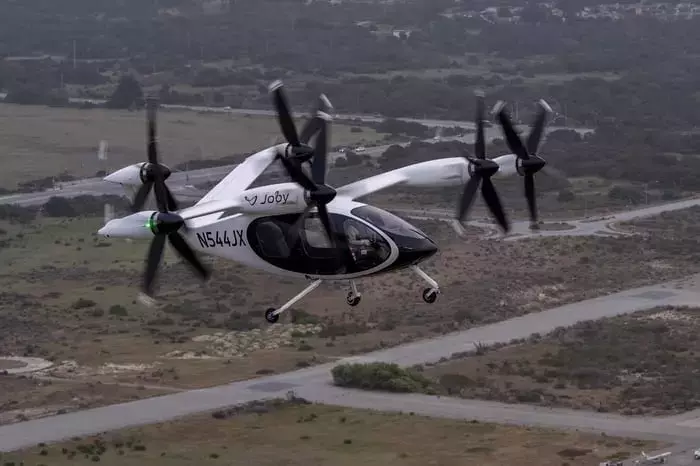
Joby Aviation is rapidly advancing towards transforming urban mobility with its electric vertical takeoff and landing (eVTOL) aircraft. The company is making significant strides in the crucial FAA certification process, demonstrating its commitment to bringing air taxi services to fruition. Backed by strategic alliances with major players such as L3Harris Technologies, Toyota Motor, and Delta Airlines, Joby is building a strong foundation for future growth. Its solid financial position further enhances its appeal to investors eager to capitalize on the emerging market for aerial transportation. As the concept of eVTOLs transitions from a futuristic idea to a tangible reality, Joby Aviation is positioning itself as a frontrunner in this exciting new era of aviation.
Joby Aviation envisions a future where individuals can effortlessly navigate congested urban landscapes by utilizing quiet, electric-powered aircraft, effectively creating an 'Uber of the skies.' While once considered a far-fetched notion, the feasibility of eVTOLs has significantly increased over the past five years, particularly in recent months. This shift is largely due to growing support from governments and airlines through favorable policies and substantial investments, alongside the developing infrastructure designs tailored for these innovative aircraft. For a company like Joby, which has yet to generate revenue, this industry-wide backing has been instrumental in elevating its market valuation to approximately $12 billion.
A critical milestone for any eVTOL developer is obtaining certification from the Federal Aviation Administration (FAA), and Joby is currently leading its competitors in this complex process. As of early August, Joby had completed 70% of its responsibilities in the fourth stage of certification, with the FAA having progressed through more than 50% of its review for this phase. The company is actively assembling an FAA-compliant aircraft for testing, a step that will propel it into the final stage of certification. Projections indicate that FAA pilots could begin flight testing Joby's aircraft as early as next year. In comparison, rival Archer Aviation's most recent updates, shared in its first and second-quarter shareholder letters, indicated that it was focusing on the fourth and final phase of its certification program, having received FAA approval for about 15% of its compliance verification documents. The White House's new eVTOL Integration Pilot Program (eIPP) is expected to further expedite the certification timelines for both companies, signaling a heightened urgency in Washington to integrate eVTOL technology into national airspace.
Despite being in a pre-revenue stage, Joby is strategically cultivating key partnerships and securing investments from prominent industrial sector entities. Early in August, Joby announced a collaboration with defense contractor L3Harris Technologies to develop a hybrid variant of its eVTOL, powered by a gas turbine, for military applications. This initiative could unlock a new revenue stream, potentially generating income for Joby even before its commercial eVTOLs become operational. Later that month, Joby finalized its acquisition of Blade Air Mobility, a move designed to secure access to critical urban infrastructure in major markets like New York City in anticipation of its eVTOL certification. Furthermore, Joby signed a memorandum of understanding (MoU) with Abdul Latif Jameel, a Saudi Arabian family business, to explore a distribution agreement for up to 200 Joby aircraft, a deal potentially valued at around $1 billion. Toyota Motor has also committed to investing $500 million in Joby, with $250 million already disbursed, and Delta Airlines has previously invested in the company, with plans to integrate Joby's air taxis into its future network.
Joby Aviation boasts a robust financial standing, concluding June with approximately $991 million in cash and short-term investments. Factoring in the additional $250 million from Toyota, the company's total liquidity reaches $1.24 billion. Given its average annual cash burn of about $500 million, Joby possesses sufficient capital to sustain operations for roughly two years without needing further external funding. This strong balance sheet provides a crucial buffer as the company navigates the final stages of development and certification, underscoring its financial resilience in a capital-intensive industry.
The journey of groundbreaking technology inevitably reaches a point where theoretical concepts begin to materialize into tangible applications. Joby Aviation appears to be on the cusp of such a transformation. While it's important to acknowledge the inherent challenges and the company's current pre-revenue status, the momentum is undeniably in Joby's favor. For investors who recognize the immense potential of eVTOLs to redefine urban transportation and unlock entirely new markets, now may be an opportune moment to consider investing in Joby's stock, anticipating a future where air taxis are a common sight in our skies.
