
This analysis evaluates Lemonade and Root, two innovative insurance technology companies founded approximately a decade ago with the ambition of transforming the insurance sector. It highlights their shared commitment to leveraging technology for operational efficiency and market disruption, while also contrasting their specialized approaches and financial performance. The article aims to guide investors in identifying which of these rapidly evolving fintech entities presents a more advantageous opportunity for portfolio inclusion.
Insurtech Innovators: A Deep Dive into Lemonade and Root's Investment Potential
The Disruptive Vision of Lemonade and Root in Insurance
Lemonade Insurance and Root Insurance were both established around 2015, sharing a common objective: to revolutionize the conventional insurance landscape through cutting-edge technology. Both organizations harness mobile applications, automation, and advanced data science to streamline underwriting processes, minimize customer friction, and better serve their clientele. However, throughout their expansion phases, both have encountered difficulties in achieving consistent profitability, primarily due to elevated loss ratios.
Distinguishing Features: Root's Auto Focus vs. Lemonade's Diverse Offerings
Root's operational model is centered on offering auto insurance, employing telematics to evaluate driving habits and dynamically determine risk profiles. Its application meticulously records acceleration, braking, and turning behaviors to customize premiums, making Root's underwriting profoundly influenced by individual behavior. The company asserts that car insurance rates should be exclusively based on driving conduct, rather than demographic data and other conventional factors used by insurers. It leverages extensive data, combined with machine learning and artificial intelligence (AI), to precisely price insurance and adapt to economic shifts. Root utilizes data from two to four weeks of test drives via smartphone, analyzing thousands of variables, including distracted driving, to identify and avoid high-risk drivers, who are reportedly twice as likely to be involved in accidents as its target customers.
Conversely, Lemonade provides a broader spectrum of insurance products, encompassing coverage for renters, homeowners, pets, life, and automobiles. The company was an early adopter of AI chatbots, integrating them across its operations from policy purchasing to claims processing, thereby ensuring a seamless customer experience. Lemonade Car has emerged as a significant growth engine, exceeding $150 million in in-force premiums in the second quarter of this year. This automotive insurance product is currently available in 10 states, covering roughly half of the U.S. car insurance market, with plans for expansion into additional states by the close of 2026.
Evaluating Investment Prospects: Which Stock Offers Greater Value?
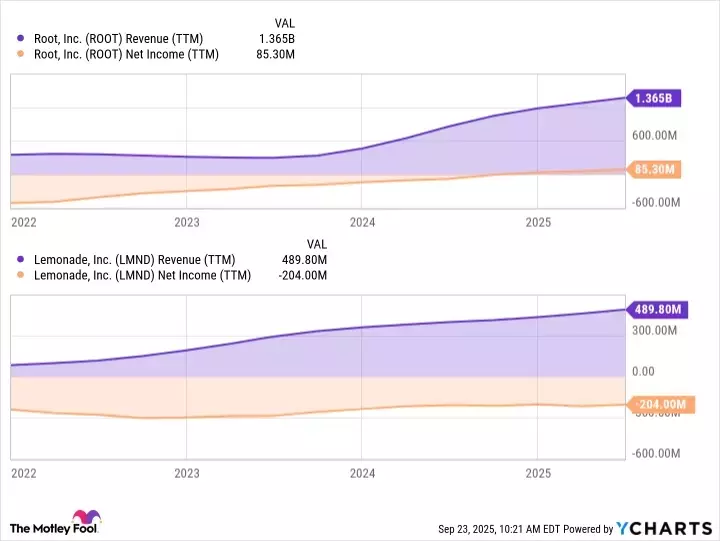
Lemonade typically garners more attention from investors and boasts greater brand recognition. Its sophisticated application of AI has positioned it as a prominent player in the fintech sector, demonstrating tangible progress. Nonetheless, Root has advanced further in terms of financial viability. Last year, the company reported positive net income under generally accepted accounting principles (GAAP), achieving earnings per share (EPS) of $1.54. In contrast, Lemonade recorded a loss per share of $3.07. Analysts project Root to achieve an EPS of $1.49 this year and $2.55 next year. Meanwhile, Lemonade is expected to sustain a loss per share of $2.69 this year, which is anticipated to narrow to $1.63 in 2026. In terms of valuation, Root is trading at 1.3 times its trailing-12-month sales, while Lemonade is valued at 6.9 times its sales. While Lemonade is making commendable strides in enhancing its underwriting profitability, it still faces a considerable journey towards achieving overall profitability. Root, on the other hand, has already established profitability and offers a more attractive valuation. For these compelling reasons, Root currently appears to be the more favorable investment choice.
