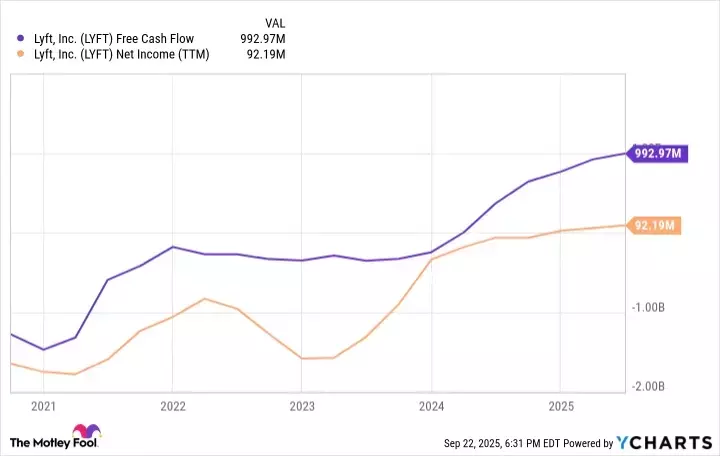

Lyft, a prominent player in the ride-hailing sector, is experiencing a notable revitalization, marked by a new collaboration with Waymo, a leader in self-driving technology. This partnership is set to introduce autonomous ride-sharing services in Nashville, reflecting Lyft's strategic efforts to innovate and expand its market presence. The company's renewed vigor is also evident in its recent financial performance, demonstrating positive free cash flow and a growing share of the U.S. market, positioning it as an intriguing prospect for investors.
Lyft's Strategic Turnaround: Navigating Autonomous Futures and Market Competition
Lyft's Ascendance: Regaining Momentum in the Ride-Hailing Sector
For a period, industry observers largely dismissed Lyft in favor of its larger rival, Uber Technologies. However, Lyft has commenced a remarkable recovery, with its stock performance surpassing Uber's this year. This shift is primarily attributed to Lyft's successful efforts in recapturing a portion of the U.S. market and achieving consistent positive free cash flow.
Forging Alliances: Lyft's Collaboration with Waymo in Nashville
On September 17th, Lyft announced a significant collaboration with Waymo, a leading company in autonomous vehicle technology, to deploy ride-sharing services in Nashville. This alliance marks a crucial development for Lyft as it explores the opportunities and challenges presented by self-driving cars. Under this arrangement, Waymo's vehicles in Nashville will be managed by Lyft's Flexdrive service, which includes maintenance, cleaning, and recharging. This partnership was well-received by investors, leading to a more than 10% increase in Lyft's stock value last week.
Navigating the Dual Role of Waymo: Partner and Potential Rival
While Waymo currently serves as a partner to Lyft, its future role could evolve into that of a formidable competitor. Customers in Nashville will have the option to request a Waymo self-driving vehicle through either the Lyft platform or directly via the Waymo mobile application. In other cities, Waymo has successfully attracted users directly through its own app, suggesting a potential for direct competition even while collaborating. This is not Lyft's sole venture into autonomous driving, as it also secured an agreement with Mobileye in 2024.
Lyft's Solid Market Position in the United States
Autonomous vehicles represent both a challenge and an opportunity for Lyft in the long term. In the immediate future, the company's primary focus remains on competing effectively with Uber, the dominant force in the ride-hailing industry. Under the leadership of CEO Dave Risher, who joined in 2023, Lyft has made substantial strides. Its market share in the U.S. has increased from 26%-27% to 30%-31%, driven by more competitive pricing and innovative features, such as enabling female riders to select female drivers. Lyft has also expanded internationally, with Canada being its first foray outside the U.S., alongside the growth of its Flexdrive program.
Financial Resilience and Growth Trajectory
This strategic turnaround has fueled Lyft's revenue growth, with the last quarter's revenue reaching $1.59 billion, an 11% year-over-year increase. Crucially, the company has achieved positive cash flow, demonstrating its capacity for profitable operations despite being the underdog. Over the past year, Lyft reported a net income of $92 million and an impressive free cash flow of $993 million.
Investment Outlook: Is Lyft Stock a Worthwhile Purchase?
Having seen its stock price climb by 75% in 2025, Lyft now commands a market capitalization of $9.2 billion. This valuation appears modest when compared to its trailing free cash flow generation and Uber's substantial $200 billion market value. However, when considering net income, which accounts for non-cash expenses like insurance reserves and stock-based compensation, Lyft's stock, with a price-to-earnings ratio of approximately 100, seems less undervalued. Despite this, Lyft potentially has considerable scope to enhance its profit margins, given that its net income constituted only 0.9% of the total booking volume on its platform last quarter. Risher and his team have successfully steered Lyft towards a more stable financial position, alleviating concerns about bankruptcy. The company continues to exhibit steady revenue growth and is actively pursuing new opportunities, such as the Waymo partnership. While the stock may not appear to be an absolute bargain, Lyft could still offer significant value for investors willing to commit for five years or more.
