
This article explores the compelling advantages of the Schwab U.S. Dividend Equity ETF (SCHD) for investors seeking consistent income. It highlights how dividend ETFs offer both regular payouts and crucial diversification, mitigating risks associated with individual stock choices. The piece positions SCHD as a leading option for 2025, emphasizing its strategic focus on robust dividend payers and superior financial health, making it an attractive choice for those prioritizing stable returns.
For individuals focused on generating income through their investments, dividend exchange-traded funds (ETFs) present a highly appealing strategy. Unlike investing in single dividend stocks, which requires meticulous research to identify growth potential and consistent payouts, ETFs offer instant diversification. This diversification spreads risk across numerous companies, ensuring that the portfolio remains stable even if a few holdings underperform. For example, while a high-growth stock like Nvidia might offer substantial capital appreciation, its minimal dividend payout makes it less suitable for income-focused investors. In contrast, dividend ETFs are specifically designed to deliver regular income, providing a more predictable financial flow.
Among the many dividend ETFs available, the Schwab U.S. Dividend Equity ETF (SCHD) is particularly noteworthy. Managed by Charles Schwab Asset Management, a prominent financial institution, SCHD tracks the Dow Jones U.S. Dividend 100 Index. This index comprises companies with a history of reliable dividend payments and strong financial fundamentals. The ETF's passive management approach results in a remarkably low expense ratio of just 0.06%, translating to minimal annual fees for investors. With total net assets reaching $71 billion, SCHD demonstrates significant scale and investor confidence, solidifying its position as a top choice for dividend-seeking investors in 2025.
SCHD's portfolio is strategically allocated across sectors known for their dividend stability, including healthcare, consumer staples, industrials, and energy. Its top holdings feature major companies such as AbbVie, ConocoPhillips, Chevron, Home Depot, and Lockheed Martin, all of which contribute to the ETF's attractive dividend yield. While the payout amounts from the ETF may fluctuate quarterly due to the varying dividend schedules of its constituent companies, the overall consistency of income remains a core benefit. This structure ensures that investors receive distributions regularly, providing a reliable income stream that is often superior to other broad market funds.
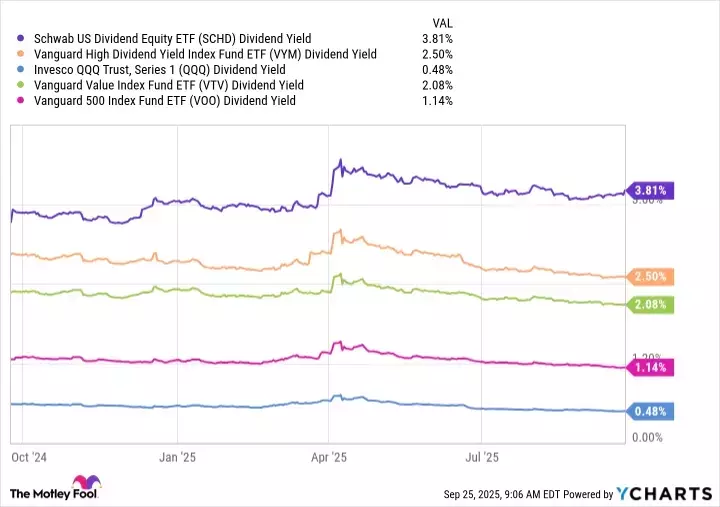
The competitive edge of the SCHD ETF is particularly evident when compared to other funds in its category. It consistently offers one of the highest dividend yields, surpassing alternatives like the Vanguard High Dividend Yield Index Fund ETF and even broad index funds such as the Vanguard Value Index Fund ETF. For instance, while the Invesco QQQ Trust, heavily weighted towards technology, yields a mere 0.5%, SCHD’s yield is significantly higher, making it a clear winner for those whose primary objective is income generation. This strong yield, combined with the underlying quality of its holdings, makes SCHD a standout option in the dividend ETF landscape.
Despite its many strengths, SCHD does have a limited exposure to the technology sector. This is primarily because many high-growth tech companies, while offering substantial capital gains, tend to reinvest profits rather than distribute them as dividends. Consequently, some of the best-performing tech stocks may not meet SCHD's stringent dividend criteria. Therefore, while SCHD is an excellent foundation for an income-focused portfolio, investors keen on capitalizing on major technological trends, such as artificial intelligence, might consider supplementing their holdings with a specialized tech ETF or a selection of top-performing tech stocks. This approach allows for a balanced portfolio that combines reliable income with exposure to high-growth opportunities, optimizing overall investment potential.
