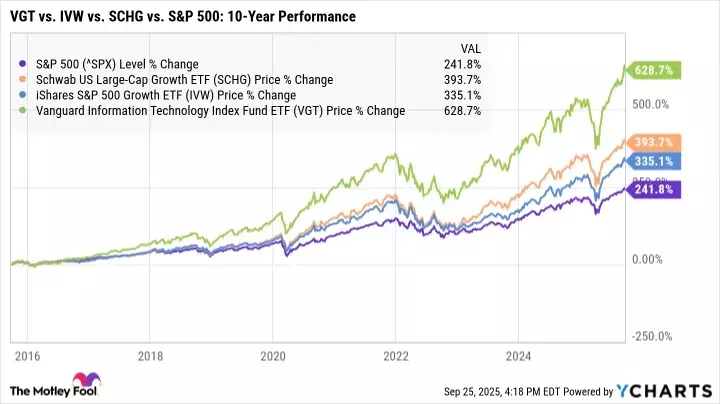

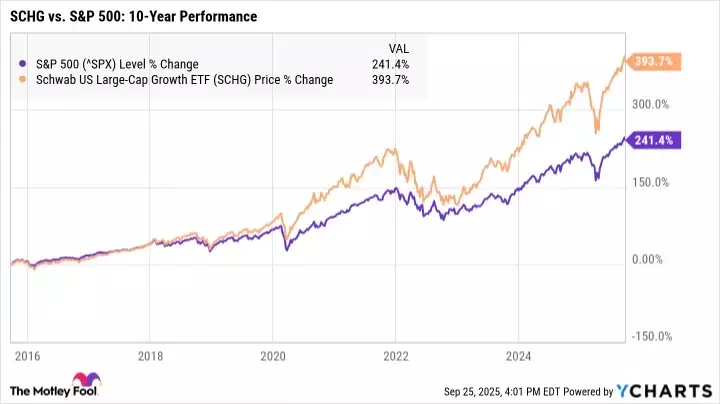
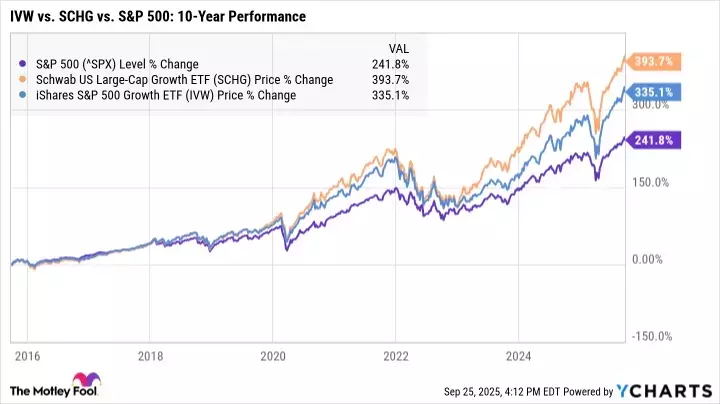
Investing in growth-oriented Exchange Traded Funds (ETFs) presents a compelling strategy for individuals aiming to achieve returns that surpass the broader market. While the S&P 500 index has demonstrated robust performance over the past decade, certain growth ETFs have delivered even more impressive results, offering a pathway to potentially substantial wealth accumulation. However, it's crucial for investors to understand that higher potential returns often come with increased risk, necessitating a balanced approach and a long-term perspective. This analysis delves into three such ETFs, examining their composition, historical performance, and the strategic considerations for integrating them into a diversified investment portfolio.
These growth ETFs are designed to capture the upside potential of companies expected to experience above-average growth in earnings. By focusing on firms poised for expansion, these funds aim to deliver superior performance compared to more broadly diversified index funds. Each ETF discussed here offers a distinct flavor of growth investing, from broad large-cap growth exposure to a specialized focus on the technology sector. Despite their differing focuses, a common thread is their historical ability to outpace the S&P 500, making them attractive options for investors with a suitable risk tolerance and investment horizon.
Understanding High-Growth ETFs and Their Performance Drivers
Growth ETFs primarily target companies with the potential for accelerated earnings and revenue expansion, making them attractive for investors seeking to amplify their portfolio's returns. Unlike broad market index funds, these ETFs concentrate on sectors and companies exhibiting strong innovation, market leadership, and robust growth prospects. While this focus can lead to greater volatility, the historical performance of funds like the Schwab U.S. Large-Cap Growth ETF, the iShares Core S&P 500 Growth ETF, and the Vanguard Information Technology ETF demonstrates their capacity to significantly outperform benchmarks such as the S&P 500 over extended periods. This outperformance is driven by their strategic allocation to high-potential equities, which can lead to substantial capital appreciation.
These specialized funds carefully select stocks based on various growth metrics, ensuring that their holdings are poised for future expansion. For instance, the Schwab U.S. Large-Cap Growth ETF focuses on established large-cap companies that still offer significant growth opportunities, thereby mitigating some of the risks associated with smaller, less mature growth stocks. Similarly, the iShares Core S&P 500 Growth ETF zeroes in on growth companies already part of the prestigious S&P 500, offering a blend of stability and growth potential. The Vanguard Information Technology ETF, on the other hand, provides concentrated exposure to the highly dynamic technology sector, which has historically been a significant driver of market growth. Each fund's unique strategy aims to capitalize on distinct growth drivers within the market, translating into impressive long-term returns for investors.
Strategic Integration of Growth ETFs into Your Investment Portfolio
Incorporating growth ETFs into an investment portfolio requires a thoughtful strategy that balances the pursuit of high returns with prudent risk management. While these funds offer compelling growth potential, their inherent volatility means they should ideally be part of a broader, diversified portfolio. Investors should consider their individual risk tolerance and investment horizon before committing a significant portion of their capital to these more aggressive assets. A long-term perspective is particularly important, as the market value of growth stocks can fluctuate considerably in the short term, but tend to recover and grow over several years.
To mitigate risks, it's advisable not to make growth ETFs your sole investment. A well-diversified portfolio typically includes a mix of assets, such as value stocks, bonds, and other types of ETFs, to spread risk across different market segments and economic conditions. For instance, while a tech-focused ETF like the Vanguard Information Technology ETF can deliver explosive returns, it's susceptible to sector-specific downturns. Therefore, combining it with funds that invest in other industries or have different investment philosophies can help smooth out overall portfolio performance. Regular rebalancing and a clear understanding of the underlying holdings are also essential for effectively managing a portfolio that includes high-growth ETFs, ensuring it remains aligned with your financial objectives and risk profile.
