
When evaluating investment opportunities, a dividend yield as substantial as the 14% offered by AGNC Investment, a mortgage real estate investment trust (mREIT), naturally captures attention. This figure dwarfs the 1.2% yield of the S&P 500 index and the 3.8% average for REITs. However, such an unusually high yield warrants careful consideration, especially for those prioritizing a stable and consistent income stream for long-term financial planning.
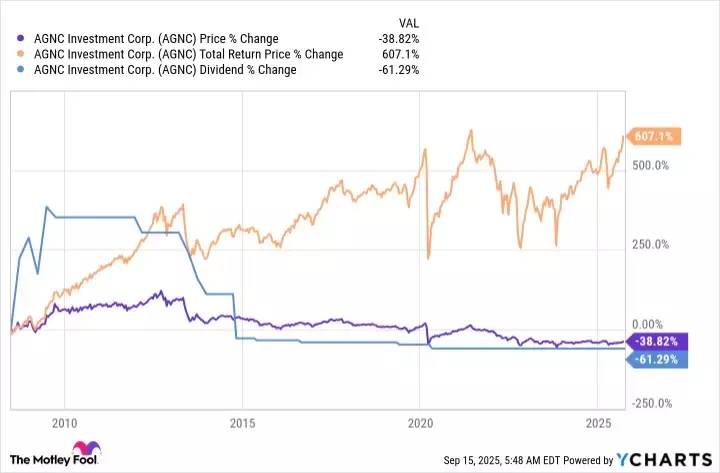
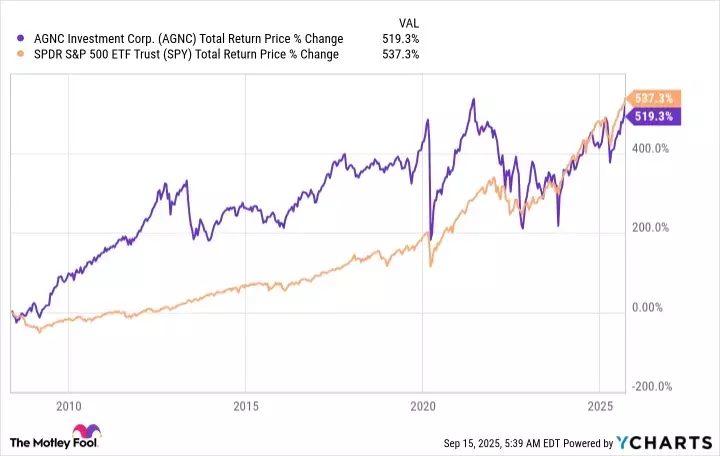
While AGNC Investment generally operates as a well-managed mREIT, and its total return since its initial public offering (IPO) has been competitive with the S&P 500, suggesting its potential as a diversification tool, it presents a unique challenge for dividend investors. The core issue lies in the composition and historical volatility of its dividend payouts. The company primarily invests in mortgage-backed securities, meaning that the payments it receives and subsequently distributes as dividends are a blend of interest and principal. Consequently, a portion of the dividend received by investors is effectively a return of their initial capital, which, over time, can lead to a reduction in the portfolio's underlying asset value. This mechanism explains why, despite its strong total return, the dividend payments have been notably unstable and have generally trended downwards for an extended period, making it an unreliable source for sustained income needs.
Ultimately, AGNC Investment caters to a specific investor profile, and its intricacies necessitate a thorough understanding before commitment. While it is not inherently a poor investment, its dividend structure—characterized by a blend of interest and principal and a history of significant fluctuations—makes it ill-suited for investors who rely on predictable, growing dividend income, particularly for retirement planning. The company itself emphasizes a total return objective over consistent dividend distributions. Therefore, those seeking dependable dividend payments should exercise caution and critically assess whether this high-yield offering aligns with their income stability requirements, rather than being swayed solely by the attractive percentage.
In the dynamic world of finance, discerning the true nature of an investment's returns is paramount. While the allure of high dividend yields can be strong, a deeper analysis often reveals complexities that challenge the notion of effortless passive income. True financial wisdom lies in understanding these underlying mechanics, prioritizing sustainable growth and reliability over superficial gains, and aligning investment choices with one's genuine financial objectives and risk tolerance. This disciplined approach fosters resilient portfolios and empowers investors to navigate market fluctuations with greater confidence and foresight.
