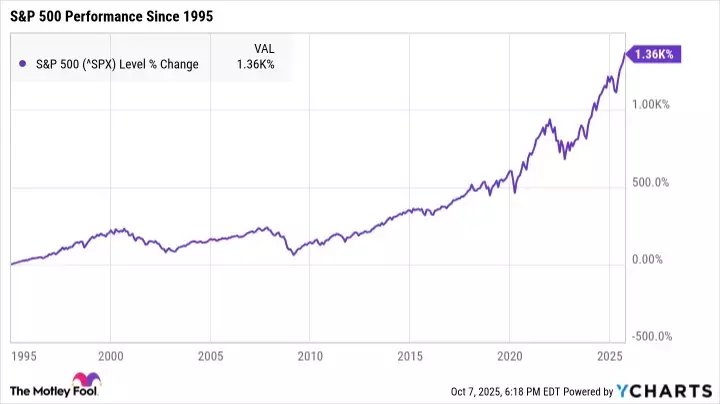

The S&P 500 is on track for an unprecedented third consecutive year of substantial total returns, a phenomenon not seen since the late 1990s, just before the dot-com bust. This historical parallel raises questions about potential market overvaluation, with a key metric, the Buffett Indicator, signaling record-high levels. While such indicators offer valuable context, the evolving nature of the market, particularly the rapid growth of the tech sector, suggests a cautious yet balanced approach to investment. Investors are reminded that market downturns are inevitable, but focusing on long-term strategies and portfolio resilience remains paramount rather than attempting to time the market based on short-term predictions.
The current trajectory of the S&P 500 is making headlines, as it potentially reaches a significant milestone: achieving total returns exceeding 20% for three years in a row. This impressive performance, following gains of approximately 24% in 2023 and 23% in 2024, places 2025 in a unique historical context. As of October 2025, the index shows a year-to-date return of around 14%, indicating that the target of 20% by year-end is still within reach. The last time such a consecutive streak occurred was in the period leading up to the infamous dot-com bubble collapse, prompting many to wonder if the market is once again experiencing an unsustainable surge.
A critical tool for assessing market valuation, the Buffett Indicator, also known as the 'market cap to GDP' ratio, suggests a state of extreme overvaluation. This metric, famously championed by Warren Buffett, measures the total market value of all publicly traded U.S. stocks against the country's Gross Domestic Product. Historically, Buffett suggested that a ratio between 70% and 80% indicates a safe investment environment, while a ratio of 200% or more implies significant risk. In 2025, the indicator stands at an unprecedented 221%, surpassing its previous peak during the 1999-2000 tech bubble. This figure could be a red flag, hinting at a market that is 'playing with fire,' as Buffett himself warned.
Despite the concerning signals from historical data and indicators like the Buffett Indicator, it's crucial for investors to exercise discernment. Market experts often point out that no single metric can perfectly predict future market movements. Critics of the Buffett Indicator argue that its relevance might have diminished due to structural changes in the economy, particularly the explosive growth and high valuations of the technology sector. Modern tech giants command valuations far exceeding those of leading companies decades ago, potentially skewing the ratio without necessarily implying an immediate crash. For instance, if investors had shunned the market when the indicator dipped below 80% in 2012, they would have missed out on substantial growth.
Ultimately, the stock market's short-term behavior remains inherently unpredictable. While historical patterns and valuation metrics like the Buffett Indicator provide valuable insights, they are not infallible predictors of future performance. A market correction or downturn is an eventual certainty, but pinpointing its exact timing is an elusive endeavor. Instead of reacting impulsively to short-term fluctuations or dire predictions, a more prudent investment strategy involves maintaining a long-term perspective, continuously investing in a diversified portfolio, and ensuring that one's financial holdings are robust enough to withstand potential market volatility. Preparing for storms, rather than trying to dodge every raindrop, is often the most effective approach for sustained investment success.
