
In a period marked by global geopolitical tensions, economic downturns, and fluctuating employment statistics, the financial markets are bracing for potential instability. Investors are faced with the challenge of safeguarding their assets while simultaneously seizing growth opportunities. The Invesco QQQ Trust, an exchange-traded fund that tracks the Nasdaq-100 Index, has emerged as a focal point for discussion due to its significant allocation to large-cap technology companies. This analysis delves into the characteristics of the QQQ ETF, assessing its appeal for those prioritizing growth and its limitations for investors seeking income and stability, especially when compared to other available index funds.
The current investment climate is characterized by an undercurrent of caution, despite the CBOE Volatility Index (VIX) suggesting a relative calm. However, history indicates that this calm can quickly dissipate, necessitating a proactive approach to portfolio management. While some investors might lean towards more conservative assets during uncertain times, others remain keen on leveraging market resilience for continued growth. The Invesco QQQ Trust, with its unique portfolio structure, presents an intriguing proposition for the latter group.
The Invesco QQQ Trust is an index fund that is managed passively and mirrors the performance of the Nasdaq-100 Index. This index is comprised of the 100 largest non-financial companies listed on the Nasdaq Stock Market. A distinguishing feature of the QQQ is its deliberate exclusion of financial stocks, which are often susceptible to underperforming during economic contractions. This exclusion makes the QQQ an attractive option for investors looking to mitigate risks associated with the financial sector in a volatile market.
A substantial portion of the QQQ ETF, specifically 60.8%, is allocated to technology stocks. Following technology, consumer discretionary stocks constitute 19.4% of the fund. Other sectors, such as healthcare, industrials, and telecommunications, have lesser weightings, ranging from 4% to 5%, while basic materials, utilities, energy, and real estate each account for less than 2%. As a weighted-capitalization ETF, the QQQ assigns greater influence to companies with larger market capitalizations. This is evident in the fact that the top 10 holdings collectively represent 52.77% of the fund, with technology giants dominating these positions.
Among the top holdings, Nvidia leads with a 9.24% allocation, followed by Microsoft at 8.36% and Apple at 8.12%. Broadcom, Amazon, and Meta Platforms also feature prominently, with allocations of 5.90%, 5.59%, and 3.70% respectively. Google's parent company, Alphabet, appears twice with its Class A and Class C shares, contributing 3.10% and 2.91% respectively. Netflix and Tesla round out the top ten, with 2.95% and 2.90% allocations. This concentration in a few dominant technology companies underscores the fund's growth-oriented nature.
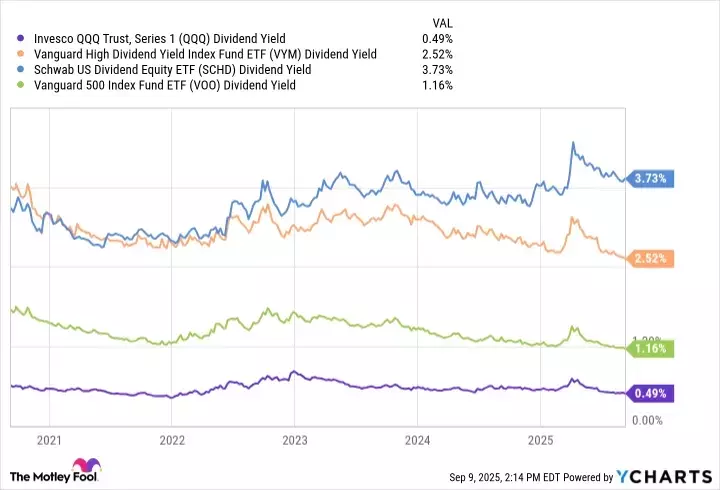
Despite its growth potential, the QQQ ETF has certain characteristics that may not suit all investors. Its expense ratio stands at 0.2%, which translates to an annual cost of $20 per $10,000 invested. This is notably higher than many other index funds; for instance, the Vanguard High Dividend ETF and the Schwab US Dividend Equity ETF both have an expense ratio of 0.06%, while the Vanguard S&P 500 ETF is even lower at 0.03%. Furthermore, the QQQ ETF offers a modest dividend yield of only 0.49%, which is not surprising given its heavy focus on growth-oriented technology companies rather than income generation.
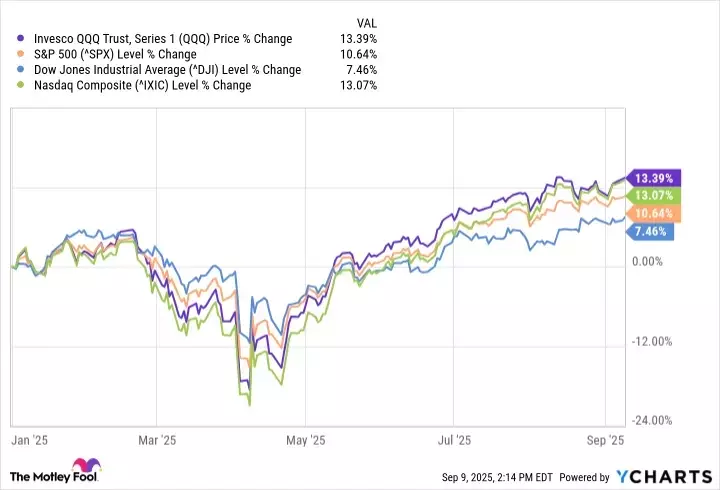
For investors prioritizing significant capital appreciation and a portfolio heavily weighted towards the technology sector, the QQQ can be an excellent choice. It has a proven track record of outperforming broader market indices during periods when technology stocks are thriving. However, for those whose primary objectives are capital preservation, stable income, or a more diversified exposure to various economic sectors, other ETFs specializing in consumer staples, utilities, or healthcare might be more appropriate. The decision to invest in QQQ ultimately depends on an investor's individual risk tolerance, financial goals, and their outlook on the future performance of the technology sector.
