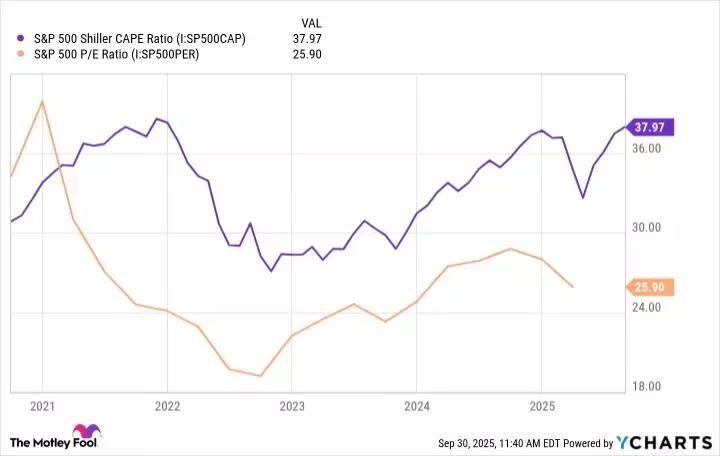

The S&P 500 has once again showcased its robust performance, advancing 14% this year despite earlier challenges. This resilience mirrors the strength of the U.S. economy, largely propelled by its dominant constituents. Exchange-Traded Funds (ETFs) tracking this index, particularly the Vanguard S&P 500 ETF, represent a popular investment avenue, managing trillions in assets. However, the current market landscape presents a dichotomy: while continued growth is possible, the elevated valuation metrics, such as a P/E ratio nearing 38 and a high CAPE ratio, suggest an increased likelihood of market pullbacks or corrections. Investors are faced with the perennial question of timing their entry, balancing the allure of ongoing gains with the potential for future volatility. The index's significant exposure to leading AI companies further underscores its growth potential while distributing risk across multiple high-performing entities.
For decades, the S&P 500 has consistently proven itself as a powerful engine for wealth creation, delivering average annual returns exceeding 10%. This compounding effect, especially with regular contributions, can significantly boost an investor's portfolio over time. Investing in an S&P 500 ETF simplifies the investment process, eliminating the need for individual stock selection. Furthermore, these ETFs provide broad access to the market's leading companies, with a notable tilt towards artificial intelligence (AI) giants. Due to its market-capitalization-weighted structure, the largest corporations in the U.S. also hold the most significant sway within the index. Currently, this includes major players like Nvidia, Microsoft, Apple, and Amazon, which together constitute approximately a quarter of the Vanguard S&P 500 ETF’s portfolio. These companies benefit from substantial long-term tailwinds in the AI sector, offering investors exposure to these growth opportunities while mitigating the concentrated risk of holding single stocks.
Despite the inherent advantages of long-term S&P 500 investments, the prevailing market conditions warrant caution. The index has been consistently setting new records, leading to concerns about its current valuation. The S&P 500's average price-to-earnings (P/E) ratio is presently near 38, marking a five-year high. Similarly, the cyclically adjusted P/E (CAPE) ratio, which accounts for inflation, is also at elevated levels, reminiscent of the period just before a market downturn in 2021. While these metrics don't guarantee an impending correction, they signal that the market is currently in an expensive phase. Historically, market growth is punctuated by dips, corrections, and even crashes, all of which are eventually overcome. Therefore, while the long-term trajectory of the market remains upward, the possibility of a near-term rebalancing due to current high valuations cannot be ignored.
Ultimately, pinpointing the exact timing of market peaks or downturns is an elusive endeavor. Attempting to time the market can lead to missed opportunities, as sustained upward trends can persist for extended periods. The fear of a correction should not deter long-term investors from participating in the market's growth. However, a pragmatic approach is advisable. For individuals who anticipate needing their invested capital in the near future, it might be prudent to consider more stable, possibly dividend-paying assets, and to approach overvalued investments, including S&P 500 ETFs, with a degree of circumspection. Conversely, for those with a long-term investment horizon and the capacity to withstand market fluctuations, investing in the S&P 500 remains an excellent strategy for achieving sustained financial growth.
