
Nebius Group has emerged as a key player in the artificial intelligence sector, driven by the escalating demand for robust AI computing power. The company's stock has seen remarkable growth, fueled by its strategic positioning and successful acquisition of major clients, most notably Microsoft. However, this rapid expansion has also led to significant debt accumulation and a high stock valuation, presenting a complex investment landscape that requires careful consideration.
Originating from Yandex, Nebius Group has strategically refocused on AI infrastructure, demonstrating impressive revenue increases. While its market presence and future potential are undeniable, the company's financial structure, characterized by substantial capital expenditures and an operating loss, along with a lofty stock valuation compared to competitors, suggest that its current share price may already reflect anticipated future successes.
The Ascent of Nebius Group in the AI Landscape
In the dynamic realm of artificial intelligence, Nebius Group has carved out a significant niche as a specialist in AI infrastructure, witnessing an extraordinary surge in sales and market value. Its stock has climbed by more than 250% in 2025, primarily propelled by the insatiable global appetite for advanced AI computing capabilities. This impressive growth underscores the company's successful pivot and acute understanding of the burgeoning AI market's needs. The strategic move to concentrate on high-performance cloud computing infrastructure for AI systems, following its separation from Yandex, has enabled Nebius to capitalize on a pivotal moment in technological evolution. The company's ability to secure a multi-year, multi-billion-dollar contract with Microsoft further validates its technological prowess and market relevance, signaling strong confidence from industry giants in Nebius's offerings and future potential.
Nebius Group's strategic timing in prioritizing AI infrastructure has proven exceptionally fortuitous, aligning perfectly with the technology industry's escalating need for greater computational capacity. This alignment has resulted in an astounding 625% year-over-year increase in second-quarter sales, reaching $105.1 million. The company's founder and CEO, Arkady Volozh, anticipates a sustained growth trajectory, a sentiment echoed by figures like Nvidia CEO Jensen Huang, who foresaw the critical role of AI-specific infrastructure—dubbed 'AI factories'—in the next industrial revolution. Beyond its core AI infrastructure, Nebius also encompasses subsidiaries in autonomous vehicles, robotics, and education technology, although their individual financial contributions remain opaque. The monumental deal with Microsoft, set to commence later this year, is expected to substantially augment Nebius's revenue, solidifying its position as a frontrunner in providing the foundational technology for AI's continued advancement.
Navigating Financial Challenges and Investment Considerations
Despite its remarkable market penetration and revenue growth, Nebius Group is concurrently confronting significant financial hurdles, particularly in managing its rapid expansion. The company's aggressive strategy to scale its capacity and construct additional data centers, essential for meeting the burgeoning demand for AI, necessitates considerable capital. In the second quarter alone, capital expenditures surged by 49% year-over-year to $91.5 million, culminating in a substantial accumulation of nearly $1 billion in debt, a dramatic increase from $6.1 million at the close of 2024. This intensive investment in infrastructure, coupled with a rise in overall expenses to $216.3 million, has resulted in Nebius recording an operating loss of $111.2 million for the quarter. While gains from securities investments allowed the company to report a net income of $584.4 million, the underlying operational unprofitability highlights the financial strain associated with its ambitious growth agenda.
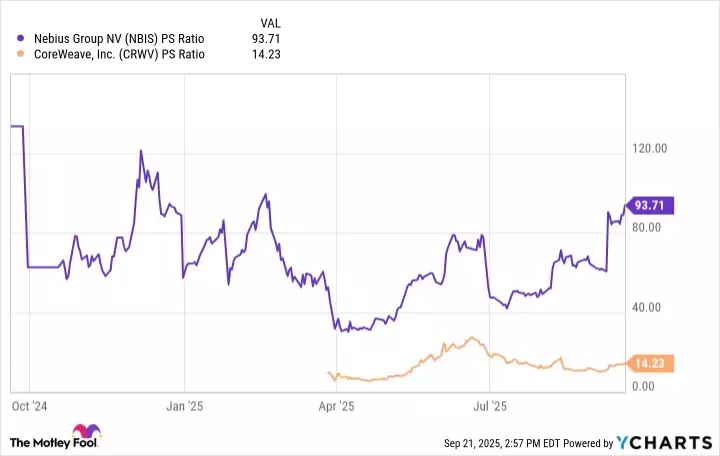
For potential investors, the decision to engage with Nebius Group stock presents a nuanced picture of high potential intertwined with considerable risk. The company's revenue prospects are undeniably robust, projected to benefit immensely from the AI market's expansion from $244 billion in 2025 to an estimated $1 trillion by 2031. This industry-wide tailwind positions Nebius favorably for long-term growth. However, the current valuation of Nebius shares, particularly when assessed through its price-to-sales (P/S) ratio in comparison to competitors like CoreWeave, suggests they are presently overvalued. The market appears to have already factored in the anticipated revenue boosts from its significant partnership with Microsoft. While Nebius has successfully secured $4.2 billion in funding to underpin its expansion, its elevated share price and escalating debt levels introduce a speculative element. Consequently, investment in Nebius Group is primarily suited for those with a high tolerance for risk, and a more opportune entry point might arise should the stock price undergo a correction.
