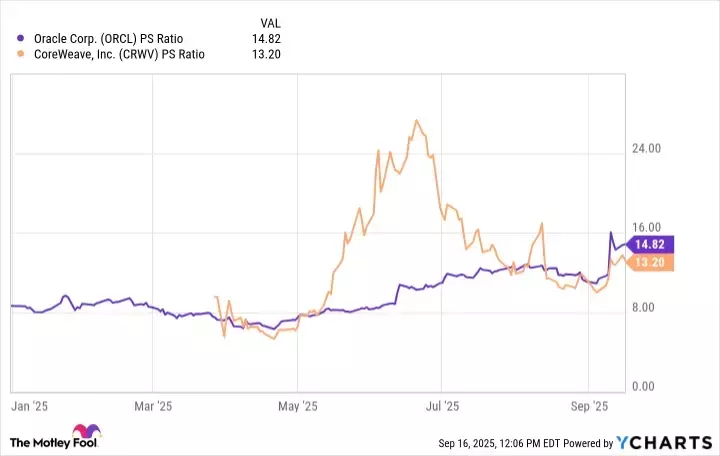

In a significant development for the artificial intelligence sector, a lesser-known but highly capable entity, Nebius Group, has emerged as a formidable competitor to established players. While the financial world has largely focused on the 'Magnificent Seven' tech giants since the rise of AI, companies like Oracle and CoreWeave have quietly carved out essential roles at the foundational level of the AI ecosystem. They address a critical need: providing cloud-based access to GPUs, which are in high demand and short supply. This has opened an avenue for firms to offer GPUs as a service, allowing businesses to rent crucial chip capacity without the burden of direct acquisition, thus saving time and reducing costs.
Amidst this landscape, Nebius Group recently announced a monumental five-year infrastructure agreement with Microsoft, valued at an astounding $17.4 billion. This deal dwarfs Nebius' previously projected annual recurring revenue of $1.1 billion, signifying a transformative leap in its scale and operational duration. This partnership not only firmly establishes Nebius alongside industry leaders such as Oracle and CoreWeave in the AI infrastructure domain but also serves as a robust endorsement of its technological prowess, proving its capability to meet the stringent demands of a hyperscaler like Microsoft. For Microsoft, this alliance is strategically vital, securing much-needed compute resources in an environment of chronic GPU shortages and long lead times for data center expansion, thereby mitigating internal infrastructure strain and significant upfront capital expenditures.
This landmark agreement carries profound implications for investors, highlighting that AI investment is not merely a fleeting trend but a fundamental shift in economic infrastructure. As businesses rapidly deploy AI applications, scale their workloads, and explore new use cases in areas like robotics and autonomous systems, the demand for underlying compute resources continues to grow. By securing Microsoft as a premier client, Nebius has solidified its position within this crucial segment of the AI infrastructure economy, suggesting a durable secular tailwind for its growth. While Nebius' shares saw a significant surge following the announcement, its implied forward price-to-sales ratio, when accounting for the new deal, appears attractively valued compared to its peers. Despite some caveats regarding customer churn and the viability of some larger deals by competitors, the undeniable validation from Microsoft and the persistent structural demand for AI infrastructure make Nebius a compelling long-term investment opportunity as the AI narrative continues to evolve.
