
Nvidia, a titan in the technology sector, has demonstrated impressive growth and market resilience throughout 2025, overcoming initial stock fluctuations to deliver substantial returns for investors. This success is predominantly fueled by an escalating global demand for artificial intelligence accelerators, positioning Nvidia at the forefront of this rapidly expanding market. The company's strategic dominance in AI chip manufacturing, coupled with strong performance across its diverse business units, underpins its optimistic financial outlook and projected increase in market valuation.
In 2025, Nvidia experienced a dynamic period in the stock market. The early months saw its shares dip due to export restrictions on chips to China and broader concerns regarding AI infrastructure spending. However, a significant rebound in the subsequent five months propelled the company's stock to a 32% gain for the year. This recovery highlights the underlying strength of Nvidia's business model and the critical role it plays in the AI revolution. Projections from Gartner, a renowned market research firm, underscore this trend, estimating a surge in spending on AI accelerators from $140 billion last year to $267 billion this year, and potentially reaching $330 billion by 2026. Given Nvidia's estimated 80% control of the AI accelerator market, these figures directly translate into colossal revenue opportunities for the company.
Nvidia's command over the AI accelerator market is a key driver of its financial success. In 2024, the company's AI compute chip sales amounted to $102 billion, capturing approximately 73% of the market. Should this trend persist and the market for AI accelerators indeed reach $330 billion by 2026, with Nvidia maintaining a 70% share, its data center compute revenue could skyrocket to an estimated $231 billion. This trajectory suggests a potential tripling of its AI accelerator revenue within just two years. Beyond its dominant AI data center GPU business, Nvidia's other divisions, encompassing networking, gaming, automotive, and professional visualization, are also experiencing healthy expansion. These segments collectively generated $28 billion in revenue in the last fiscal year and demonstrated nearly 29% growth year-over-year. The increasing prevalence of AI-enabled personal computers, advancements in smart vehicles, and the burgeoning field of digital twins are expected to sustain robust growth in these ancillary areas.
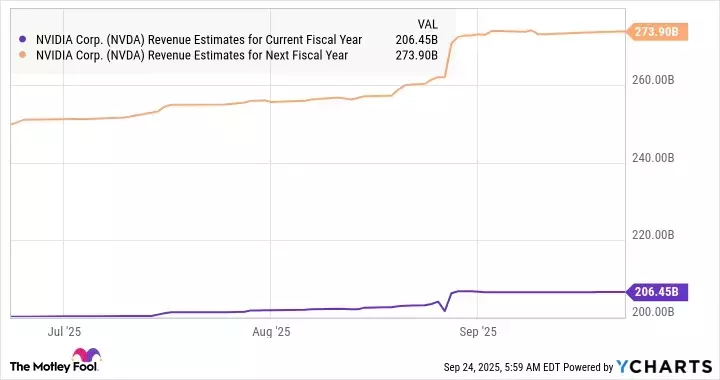
Assuming a 20% growth rate for its non-AI accelerator businesses in 2025 and 2026, these segments could contribute an additional $40 billion to Nvidia's top line in the upcoming fiscal year. This comprehensive growth across all business units positions Nvidia to generate over $270 billion in fiscal 2026, aligning with current consensus estimates. Analysts anticipate that these revenue projections may even climb higher as enterprises intensify their investments in AI applications. If Nvidia achieves $280 billion in revenue next year and maintains a price-to-sales ratio of 20 (a modest reduction from its current 26), its market capitalization could expand to $5.6 trillion. This forecast implies a substantial 30% upside for its stock price, indicating that Nvidia's journey towards a $6 trillion valuation is well within reach, underscoring its continued potential as a leading AI stock.
