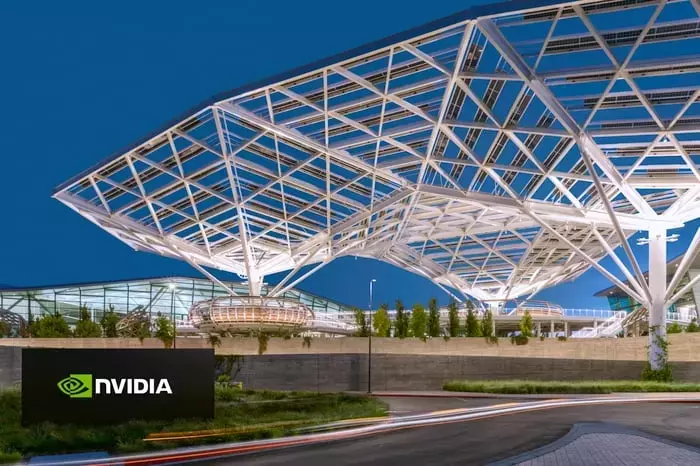
Nvidia, a leading graphics processing unit (GPU) manufacturer, has announced a significant investment of $100 billion into OpenAI, a prominent artificial intelligence research laboratory. This strategic partnership aims to construct a vast network of AI data centers, powered by millions of Nvidia’s advanced GPUs. This move follows Nvidia’s recent $5 billion investment in Intel, underscoring its aggressive expansion and commitment to dominating the rapidly evolving AI landscape. The collaboration is expected to solidify Nvidia's position in the AI infrastructure market while accelerating OpenAI's pursuit of artificial superintelligence.
The agreement between Nvidia and OpenAI is poised to revolutionize the AI industry by facilitating the development of a colossal data center infrastructure. These centers, designed to operate at an unprecedented scale, will be capable of housing between 4 to 5 million GPUs, a volume equivalent to Nvidia's projected annual shipments. Jensen Huang, Nvidia's CEO, highlighted the sheer magnitude of this endeavor, emphasizing its importance for both companies. The initial phase of this ambitious project is slated for completion and operation in the latter half of 2026, leveraging Nvidia's forthcoming Vera Rubin platform chips.
Nvidia’s financial commitment to OpenAI is part of a broader strategy to foster innovation and secure its market leadership. While the $100 billion investment will be deployed progressively as each gigawatt of data center capacity comes online, the details of the financial arrangement are still being finalized. This approach allows Nvidia to strategically align its investment with OpenAI's infrastructure development milestones, ensuring that its capital is utilized effectively as the project unfolds.
This substantial investment by Nvidia reflects a recurring pattern in its business strategy, where it frequently invests in both its customers and suppliers to create a symbiotic ecosystem. Examples include its stakes in CoreWeave and Nebius, key AI neocloud providers; Arm Holdings, whose CPU designs Nvidia licenses; and Applied Digital, with whom it collaborates on high-performance computing data centers. The OpenAI deal, however, represents Nvidia's most significant investment to date, both in terms of capital and the valuation of the invested company, with OpenAI recently valued at up to $500 billion.
The investment is mutually beneficial, as a substantial portion of Nvidia's capital will likely flow back to the company through OpenAI's procurement of GPUs for its new data centers. This circular flow of funds incentivizes OpenAI to utilize Nvidia's cutting-edge products, further cementing their partnership. Moreover, this strategic alliance serves as a formidable barrier against competitors like AMD, helping Nvidia maintain its dominant market share in the data center GPU sector.
Nvidia's proactive and insightful decisions in the AI domain, encompassing both technological advancements and strategic partnerships, are reinforcing its market leadership. By cultivating a robust network of collaborations, the company is not only entrenching its position but also diversifying its investment portfolio with ventures that promise significant returns. As long as the AI boom continues to attract substantial investment in infrastructure, Nvidia's stock is expected to demonstrate sustained growth over the long term, driven by its pivotal role in powering the AI revolution.
