Nvidia, a leading force in artificial intelligence, has recently committed a substantial $5 billion equity investment in Intel. This move represents a notable change in Nvidia's capital deployment strategy, which previously favored product innovation and share repurchases. The partnership aims to foster collaboration on advanced products for both data centers and personal computers, signaling a deeper integration of AI infrastructure. This strategic alliance is viewed as a significant endorsement of Intel's capabilities and a step towards a unified computing environment in the burgeoning AI market.
Nvidia Forges Powerful Alliance with Intel through $5 Billion Investment
In a landmark development on September 18, Nvidia, a company that has masterfully transitioned from gaming chip design to becoming a powerhouse in artificial intelligence, announced a monumental $5 billion equity investment in Intel. This strategic financial commitment goes beyond Nvidia's previous investment patterns, which were predominantly focused on internal product development like the Blackwell and Rubin chip architectures, and a substantial $60 billion share repurchase program.
This significant investment paves the way for a crucial partnership between the two technology giants, focusing on synergistic advancements in two core domains: data centers and personal computing. For the data center sector, Intel is poised to develop specialized x86 CPUs meticulously optimized for Nvidia's cutting-edge AI infrastructure platforms. Concurrently, in the personal computing realm, Intel plans to integrate Nvidia's innovative RTX GPU chiplets into its x86 system-on-chips (SOCs). This hybrid approach promises to deliver a new class of computing devices that seamlessly combine Intel's historic strength in CPU technology with Nvidia's unparalleled prowess in graphics processing for AI workloads.
The agreement underscores a pragmatic alignment where Intel's deep-rooted expertise in CPU manufacturing converges with Nvidia's leadership in accelerated AI processing. While the deal does not confer exclusive foundry status upon Intel—a segment still largely dominated by Taiwan Semiconductor Manufacturing—it provides Intel with invaluable capital and strategic validation precisely when the company is striving to regain its competitive edge in a rapidly evolving market. For Nvidia, this collaboration extends its influence deeper into the CPU ecosystem, reinforcing its comprehensive leadership in end-to-end AI infrastructure. This mutual benefit highlights a shared vision for the future of computing, emphasizing integrated ecosystems over siloed hardware solutions.
From a market perspective, this partnership is a clear signal that the future of AI infrastructure will necessitate collaborative efforts and the blending of complementary strengths rather than a zero-sum competitive struggle. The successful execution of this alliance holds the potential to significantly accelerate the adoption of AI across both enterprise and consumer markets, further validating Jensen Huang's vision of an imminent industrial revolution driven by artificial intelligence.
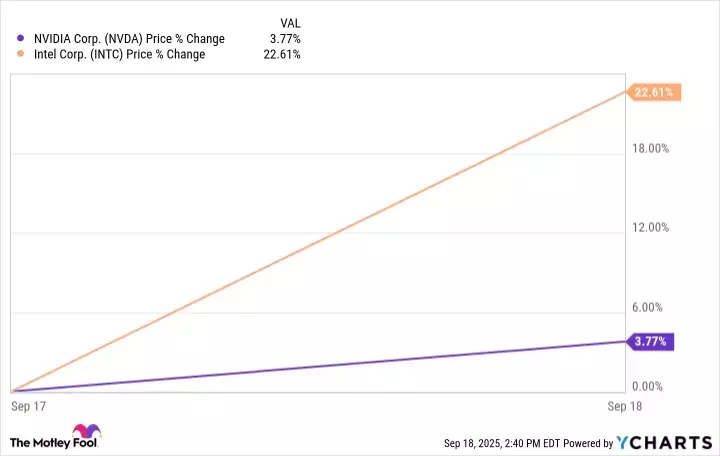
The announcement of this strategic partnership triggered a positive market reaction, with shares of both Intel and Nvidia experiencing rallies. While momentum-driven investments often carry risks, this particular scenario presents compelling long-term opportunities. Intel, despite its recent surge, remains significantly below its historical highs, making it an intriguing complementary addition to existing semiconductor or AI portfolios. However, prudence suggests a measured allocation until the concrete results of this collaboration become more apparent. For Nvidia, this deal adds another powerful catalyst to its already impressive trajectory, reinforcing its position as a core long-term holding. The true value of this alliance lies not in immediate market fluctuations, but in the profound synergies that are expected to unfold over time, propelling both companies towards even greater achievements in the technological landscape. Indeed, the best days for both Intel and Nvidia appear to be on the horizon, offering substantial buy-and-hold prospects for discerning investors with a long-term outlook.
