
The artificial intelligence sector presents numerous compelling investment avenues, with Nvidia and ASML standing out as key players. Nvidia dominates the AI semiconductor market, driven by robust demand for its high-performance chips. Meanwhile, ASML maintains a critical, monopolistic position in the production of specialized equipment essential for advanced chip manufacturing. This analysis delves into the strategic advantages, financial trajectories, and market valuations of both companies, aiming to provide a comprehensive comparison for potential investors navigating the dynamic AI landscape.
ASML's Unique Market Dominance and Growth Trajectory
ASML, based in the Netherlands, possesses an unrivaled position in the fabrication of advanced AI chips, holding a monopoly in extreme ultraviolet (EUV) lithography technology. This specialized equipment is indispensable for creating the intricate designs found in the most powerful AI semiconductors, including those produced by Nvidia. The company's unique technological edge enables it to project substantial revenue growth, with expectations to nearly double its 2024 sales by 2030, reaching between 44 billion and 60 billion euros. Despite facing export restrictions that have impacted sales to the Chinese market, ASML anticipates a 15% year-over-year sales increase in 2025, demonstrating its resilience and strong market demand.
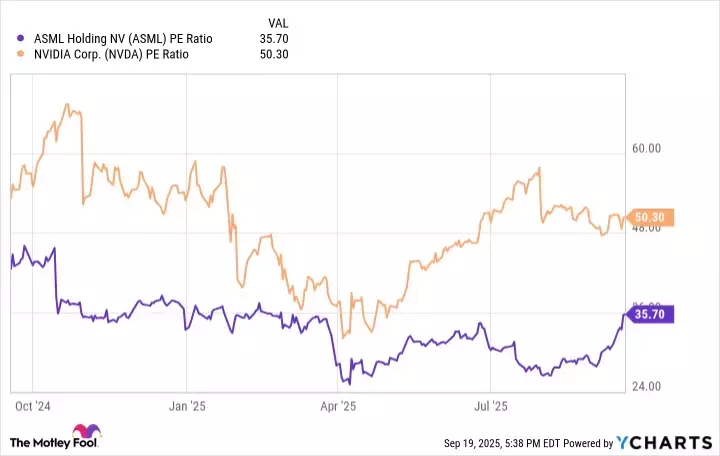
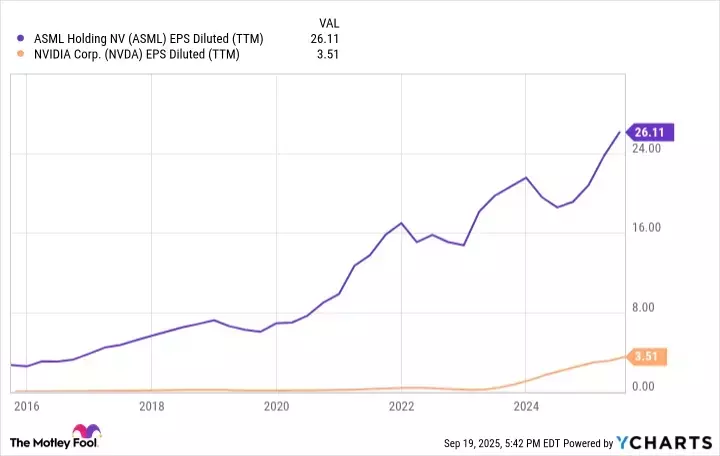
ASML's financial strength is further underscored by its impressive earnings per share (EPS) growth over the years, a trend it is well-positioned to continue. The company forecasts its gross margin to expand to between 56% and 60% by 2030, an increase from its fiscal Q2 gross margin of 53.7%. When evaluated against market metrics like the price-to-earnings (P/E) ratio, ASML's shares appear more attractively valued compared to its peers. This combination of a technological monopoly, consistent revenue growth, and favorable valuation indicators firmly establishes ASML as a highly competitive and promising investment within the AI industry, despite external geopolitical challenges.
Nvidia's AI Leadership and Market Performance
Nvidia has established itself as a frontrunner in the artificial intelligence industry, primarily due to the exceptional performance and high demand for its AI semiconductor chips. The company has experienced remarkable revenue surges, with sales to data centers—critical hubs for AI systems—increasing by 56% year-over-year to $46.7 billion in the fiscal second quarter. This growth is largely attributed to its innovative chip platforms, such as Blackwell, which integrates multiple semiconductor chips to deliver unparalleled computing power and speed for advanced AI models. CEO Jensen Huang emphasizes that the demand for AI infrastructure is akin to essential utilities like electricity, indicating a sustained and expanding market for Nvidia's products.
Despite governmental restrictions on sales to China, which resulted in a $4.5 billion write-off in fiscal Q1 due to unsold inventory, Nvidia's outlook remains robust. The company anticipates fiscal Q3 revenue to reach $54 billion, a significant increase from the previous fiscal year's $35.1 billion, even excluding sales from the Chinese market. While Nvidia's fiscal Q2 gross margin stood at 72.4%, a slight decrease from the prior year's 75.1%, its overall revenue trajectory and leadership in critical AI technologies continue to make it a compelling investment. The company's strong market position and continuous innovation in AI chip development highlight its potential for ongoing expansion and profitability in the rapidly evolving AI landscape.
