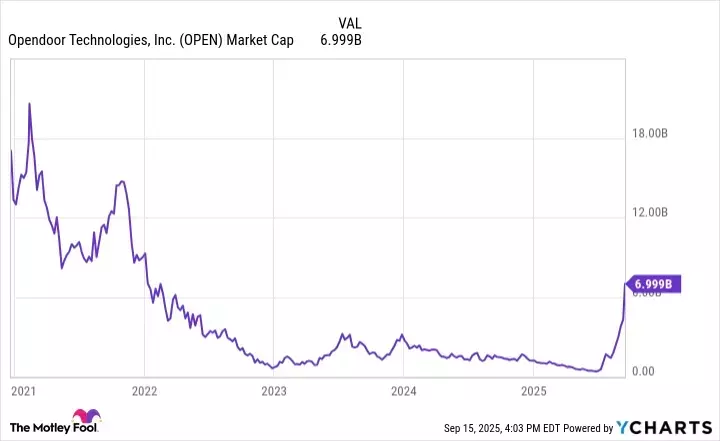

Opendoor Technologies is experiencing a notable rebound in its stock performance, largely fueled by a renewed focus on artificial intelligence and a change in executive leadership. After facing severe challenges and a dramatic drop in share value, the company's prospects appear to be shifting. However, a deeper look into its financial history reveals persistent issues with profitability and a business model that demands substantial capital, prompting investors to critically assess whether the current optimism is justified.
Opendoor Technologies, a pioneering firm in the real estate sector known for its instant cash offers on homes, had been navigating a difficult period. Earlier this year, its stock plummeted to approximately $0.50 per share, marking a staggering decline of over 95% from its peak. This severe downturn even led to discussions about a reverse stock split to bolster its share price. Yet, the company is now witnessing a significant resurgence, with its stock price soaring to nearly $10, representing a tenfold increase from its lowest point. This remarkable recovery is largely attributed to a strategic shift centered on its new CEO and innovative applications of artificial intelligence within the residential real estate market.
Kaz Nejatian, the newly appointed CEO, brings a wealth of experience from his six-year tenure at Shopify, where he served as Chief Operating Officer. His leadership at Shopify was marked by fostering a culture of innovation, significantly expanding the company's footprint in e-commerce, software solutions, and online payment processing. With Nejatian at the helm, alongside original founders Kevin Wu and Keith Rabois returning to the board, Opendoor is charting a new course. The company plans to leverage AI to develop advanced tools for real estate agents, sellers, and buyers, aiming to streamline the often-complex home transaction process. This marks a departure from its original strategy of directly disrupting the entire home-buying ecosystem through its vertically integrated iBuying model. Instead, Opendoor is positioning itself as a key software partner for real estate stakeholders, providing value through technology rather than solely through property flipping.
This strategic redirection is a direct response to the inherent financial challenges of the iBuying model, which has historically yielded low profit margins. For instance, in a recent quarter, Opendoor reported revenues of $1.6 billion but a gross profit of only $128 million, translating to a meager 8.2% margin. This figure is notably lower than even some grocery store chains, which are renowned for their lean operational models. By introducing new offerings like 'cash plus' and integrating real estate agents into its software ecosystem, Opendoor aims to generate higher-margin revenues. These services are designed to enhance the value proposition for real estate transactions without requiring the heavy capital investment and risk associated with holding a large inventory of homes, a factor that has historically impeded the company's profitability.
While the long-term success of this revised strategy remains to be seen in the financial statements, it represents a clear path forward for Opendoor under its new leadership. The company's ability to capitalize on the vast U.S. residential real estate market, which sees millions of homes sold and trillions of dollars exchanged annually, is contingent on the effectiveness of its new AI-driven approach. Before recent interest rate hikes cooled the market, approximately six million existing homes were sold each year. If Opendoor can successfully carve out a significant share of these transactions through its innovative model, its current market valuation of $7 billion could be justified.
However, the skepticism surrounding Opendoor's valuation is warranted. Many companies have attempted to revolutionize the residential real estate industry, and success is far from guaranteed. Competitors like Zillow, with its well-established real estate portal, command a market capitalization of $18 billion. Given that Opendoor is still operating at a loss and its new business model is in its nascent stages, a $7 billion valuation appears ambitious. Therefore, while Opendoor Technologies warrants continued observation for its potential to innovate in the real estate space, a cautious approach is advisable for investors, as the stock's current price may be overly optimistic given the uncertainties ahead.
