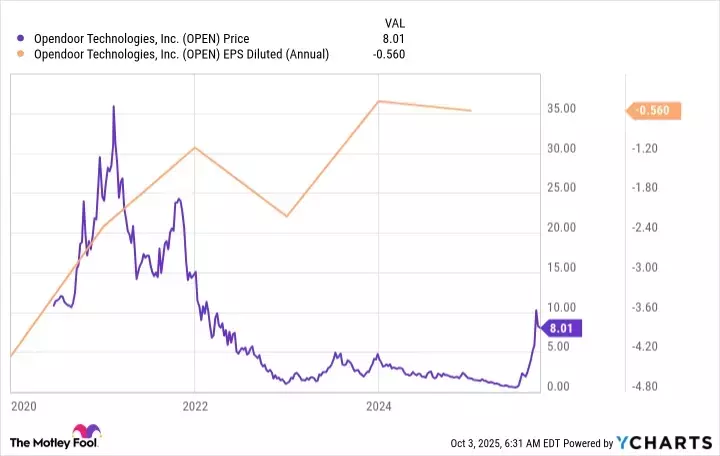

Opendoor Technologies has seen its stock price skyrocket by an astonishing 400% in 2025, primarily driven by a significant leadership change and an ambitious new strategy centered on artificial intelligence. The company, which specializes in the practice of buying, renovating, and reselling homes, is attempting to transform its business model to achieve sustainable profitability. This surge follows a period of investor disillusionment, as the company previously struggled to generate consistent earnings.
Opendoor Technologies operates as a large-scale home flipper, providing homeowners with a streamlined and expedited selling process, often bypassing the need for pre-sale renovations. The company purchases properties, invests in their refurbishment, and then relists them for a higher price. The core objective is to create a substantial profit margin by efficiently managing the acquisition, renovation, and sales cycles. Historically, this model has been more successfully executed by local, smaller-scale investors who often perform renovation work themselves to minimize costs, a factor that Opendoor has found challenging to replicate on a larger scale.
Despite its innovative approach, Opendoor has consistently faced profitability issues, failing to record a full-year profit since its inception. This has led to a significant decline in its stock value from previous highs, with many investors perceiving it as an unprofitable start-up. The company's reliance on technology for home selection has been a cornerstone of its operations, but it has yet to translate into sustained financial success.
A pivotal shift occurred recently with the involvement of an activist investor, which ultimately led to the departure of the former CEO. The subsequent appointment of Kaz Nejatian, a former Shopify executive, as the new CEO, marked a turning point. Nejatian's arrival sparked renewed investor confidence and a dramatic increase in the stock price. His vision for Opendoor is heavily focused on leveraging artificial intelligence to enhance decision-making in home buying and selling, and to reduce operational costs, including potential staff reductions.
The new CEO's strategy suggests that AI could be the key to unlocking Opendoor's profitability and enabling its expansion beyond its current limited markets. If successful, this could tap into a vast, untapped market opportunity. However, the efficacy of Nejatian's AI-driven overhaul is far from guaranteed. Implementing such extensive changes will entail substantial costs and a considerable amount of risk. Should the new strategy fail, it could jeopardize the company's future, as the human expertise displaced by AI might be difficult to recover.
Currently, investors are demonstrating significant optimism, pricing in a future where Opendoor thrives under its new AI-centric leadership. While the stock's upward trajectory could continue, fueled by the market's enthusiasm for AI-driven narratives, cautious observers might choose to monitor developments from a distance. Waiting for tangible evidence of Nejatian's plan yielding sustainable profits would be a prudent approach for most investors, given the high level of idiosyncratic risk associated with this ambitious transformation.
The company's journey from a struggling enterprise to a high-flying stock in a short period, despite minimal fundamental business changes, highlights the market's speculative nature. The allure of artificial intelligence, combined with new leadership, has created a compelling story for investors. However, the true test lies in whether Opendoor can translate this narrative into concrete financial performance and establish a truly profitable business model in the competitive real estate market.
