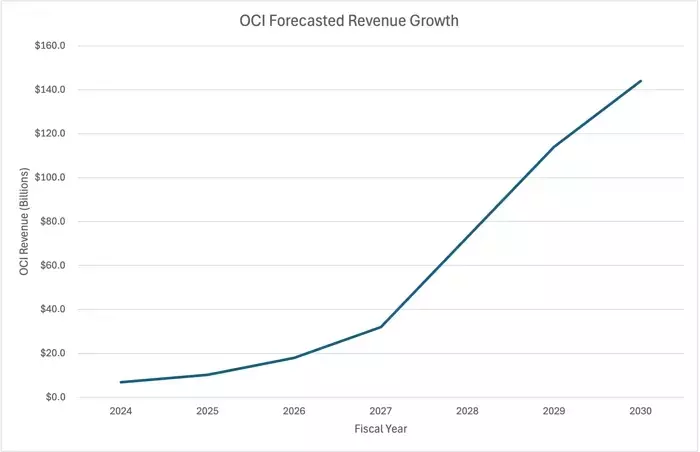

Oracle's strategic expansion into cloud computing is demonstrating remarkable success, with its stock experiencing a significant rally. The company has articulated an ambitious vision for its Oracle Cloud Infrastructure (OCI) division, forecasting exponential revenue growth that could redefine its market position. This bold trajectory, underpinned by substantial infrastructure investments and collaborative ventures, suggests Oracle is poised to join an elite group of tech giants with valuations exceeding $2 trillion, solidifying its influence in the global technology landscape.
Oracle's Cloud Computing Ascent: A Detailed Examination of its Growth Strategy
In a recent announcement on September 15, 2025, Oracle, a leading technology corporation, revealed impressive progress in its cloud computing ventures. Following the release of its fiscal first-quarter 2026 earnings on September 9, Oracle's stock experienced a substantial 36% increase on Wednesday, propelling its market capitalization to an astounding $922 billion. This surge highlights the growing investor confidence in Oracle's cloud strategy.
A core component of Oracle's growth narrative is its Oracle Cloud Infrastructure (OCI). The company projects OCI revenue to soar from an estimated $18 billion in the current fiscal year to an ambitious $144 billion by fiscal year 2030. This forecast is particularly notable given the current market landscape, where major players like Google Cloud, Microsoft's Intelligent Cloud, and Amazon Web Services (AWS) reported revenues of $33.1 billion, $105.4 billion, and $108 billion, respectively, in 2024.
Oracle's aggressive expansion plan involves a significant build-out of its data center network. The company announced intentions to deploy an additional 37 multi-cloud data centers, partnering with hyperscalers Amazon, Microsoft, and Alphabet. This will bring its total multi-cloud data centers to 71. Furthermore, Oracle is establishing dedicated standalone data centers optimized for its OCI services, including specialized AI workloads and its Exadata Database service.
The efficiency and cost-effectiveness of Oracle's newly constructed data centers are central to its competitive advantage. These advanced facilities leverage technologies like OCI bare metal instances and Remote Direct Memory Access (RDMA) cluster networking, offering superior price-performance and reduced latency for high-performance computing (HPC) workloads. This technological edge enables Oracle to provide attractive bundles, combining cloud services with existing database and enterprise offerings, thereby attracting a broader customer base.
By investing heavily in infrastructure and forging strategic partnerships, Oracle aims to disrupt the cloud computing sector. Its strategy echoes that of Broadcom, which has gained significant traction by providing XPU custom AI chips to hyperscalers, illustrating a symbiotic relationship within a competitive market. If Oracle successfully executes its ambitious OCI revenue targets, analysts suggest its stock could more than double, potentially reaching a market valuation of over $2 trillion by 2030, positioning it alongside other tech titans in the exclusive 'Ten Titans' club.
The impressive growth of Oracle, particularly within its cloud division, underscores a pivotal shift in the technology landscape, emphasizing the escalating demand for robust and efficient cloud infrastructure. This narrative highlights the critical role of strategic investment in cutting-edge technology and intelligent partnerships in achieving market dominance. For investors, Oracle's journey offers a compelling case study in long-term growth potential, contingent on disciplined execution and the ability to navigate the inherent uncertainties of rapid expansion. It serves as a reminder that the future of tech leadership lies in anticipating and aggressively pursuing the next wave of innovation.
