
In the rapidly evolving landscape of artificial intelligence, two companies, Palantir Technologies and Nvidia, have emerged as dominant forces, each experiencing remarkable growth. This analysis delves into their respective strengths and market positions to assess which company offers a more compelling investment case for the foreseeable future. Both have capitalized on the global surge in AI adoption, yet their paths and valuations present distinct considerations for potential investors.
Palantir has demonstrated impressive financial momentum, with its revenue reaching an unprecedented $1 billion in the second quarter of 2025, marking a 48% year-over-year increase. This robust performance follows a 39% growth in the first quarter, with revenues of $884 million. Consequently, Palantir has revised its full-year 2025 revenue projections upwards to $4.1 billion, a significant leap from the $2.9 billion reported in 2024. The cornerstone of this success is its Artificial Intelligence Platform (AIP), which thrives on extensive data analysis capabilities.
Palantir's expertise in data analytics, honed through its historical work with government intelligence agencies, provides a unique advantage in the AI domain. This deep understanding of data positions it as a critical enabler for AI functionalities. Furthermore, Palantir is diversifying its offerings to sustain its growth trajectory. Its FedStart product assists businesses in navigating the complexities of federal compliance, leveraging its government sector experience. Additionally, the Warp Speed solution, adopted by the U.S. Navy for shipbuilding modernization, employs AI to optimize manufacturing processes.
Nvidia, a powerhouse in advanced semiconductor chips, has also ridden the wave of AI-driven demand. The company reported a staggering $46.7 billion in revenue for its fiscal second quarter, ending July 27, representing a 56% year-over-year increase. Despite facing governmental restrictions on chip sales to China, a major AI market, Nvidia projects fiscal third-quarter sales of $54 billion, far surpassing the previous year's record of $35.1 billion, which included Chinese sales. Nvidia's Blackwell chip, introduced last year, was specifically designed for AI infrastructure, and its successor, Vera Rubin, is slated for a 2026 launch, underscoring its continuous innovation.
Nvidia's strategic partnerships further solidify its market leadership. In September, the company announced a collaboration with OpenAI, the creator of ChatGPT, involving the adoption of Vera Rubin chips to power a massive AI data center initiative requiring millions of Nvidia chips. CEO Jensen Huang hailed this as the largest AI infrastructure project ever conceived. Moreover, Nvidia made a $5 billion investment in Intel in September, aiming to integrate its products into Intel's AI data center and personal computing solutions, thereby expanding its influence across key AI industry players.
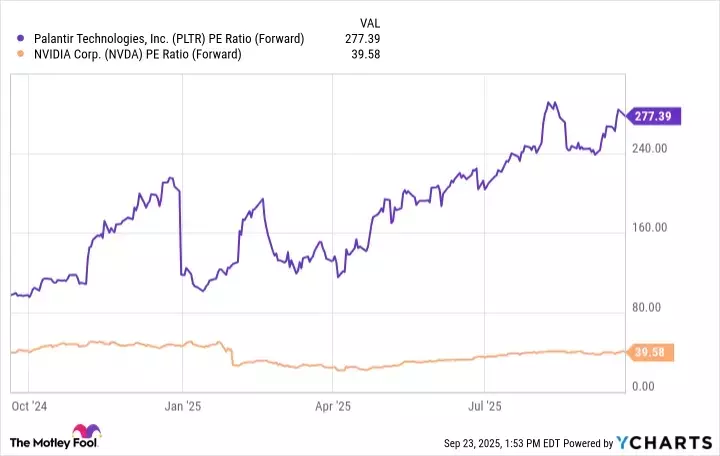
When evaluating these two AI giants, a crucial differentiator for investors lies in their share price valuation, specifically the forward price-to-earnings (P/E) ratio. This metric indicates how much investors are willing to pay for future earnings. Palantir's forward P/E multiple has seen a steady increase, currently sitting significantly higher than Nvidia's, suggesting that Palantir's shares are considerably more expensive. This elevated valuation for Palantir is challenging to justify, especially when considering Nvidia's robust position in AI chip technology, its expanding influence through strategic investments in companies like Intel and OpenAI, and its sustained sales growth despite market restrictions.
Considering these factors, including Nvidia's superior valuation metrics and its strategic dominance in the fundamental hardware powering the AI revolution, Nvidia presents itself as the more advantageous long-term investment in the artificial intelligence sector compared to Palantir.
