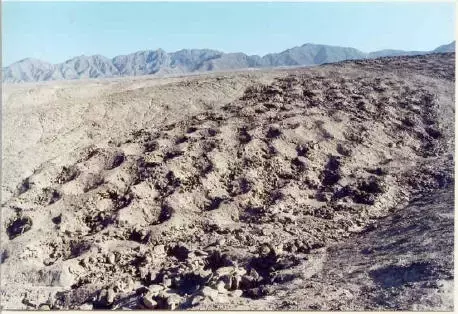
New research sheds light on an archaeological enigma in Peru, proposing a novel interpretation for the mysterious "Band of Holes" in the Pisco Valley. This extensive formation of circular depressions, stretching almost a mile, is now believed to have been a significant pre-Inca trading center that was subsequently integrated into the Inca Empire's sophisticated administrative systems.
Unlocking the Secrets of Monte Sierpe: A Pre-Columbian Trading Enigma
Unraveling the Mystery of Peru's Ancient Geoglyphs
Scholars from the University of Sydney have unearthed compelling evidence that could finally demystify the enduring archaeological puzzle known as the “Band of Holes.” This remarkable stretch, nearly a mile long, features over 5,000 circular depressions meticulously carved into the desert landscape of Peru’s Pisco Valley. For decades, the purpose of these enigmatic formations has eluded historians and archaeologists alike, leading to numerous theories and much speculation.
From Pre-Inca Trade Hub to Inca Accounting System
A recent study, spotlighted by Science Daily and published in Antiquity on November 10, posits that this site, formally recognized as Monte Sierpe, which translates to “serpent mountain,” likely operated as a sprawling marketplace for pre-Inca civilizations. Over time, the Inca Empire is thought to have adapted and incorporated this location into its complex system for tracking goods and managing resources, transforming a trading post into a key element of its administrative network.
Innovative Research Techniques Uncover Hidden Meanings
Jacob Bongers, a lead author of the study and a digital archaeologist at the University of Sydney, along with his dedicated team, employed cutting-edge technology including high-resolution drone mapping and detailed soil analysis. Their work revealed intricate geometric configurations within the holes that bear a striking resemblance to the structure of khipus, the knotted-string recording devices utilized by the Inca for inventory and tribute management. This crucial discovery points towards a sophisticated organizational purpose for the site.
Evidence of Ancient Commerce: Maize and Reeds
Analysis of soil samples yielded traces of both maize and reeds, materials integral to ancient food production and weaving. These findings suggest that the depressions once contained plant products, potentially stored within baskets. Bongers interprets this as strong evidence of a bustling pre-Hispanic marketplace where merchants, cultivators, and fishers would convene to exchange regional commodities such as corn and cotton. This paints a vivid picture of economic activity predating European arrival.
Expanding Our Understanding of Indigenous Practices
Bongers emphasized the significance of these revelations, stating to Science Daily that this represents an extraordinary breakthrough. He noted that the findings significantly broaden our comprehension of the origins and diverse forms of Indigenous accounting practices, not only within the Andes region but globally. The study offers a fresh perspective on how ancient societies managed their economies and resources, highlighting their ingenuity and organizational skills.
Drone Imagery Reveals Unseen Complexity
This research constitutes the most thorough scientific examination of Monte Sierpe since the 1930s, when initial aerial photographs first brought the site to international attention. Modern drone imagery, however, has unveiled deliberate segmentation and symmetry in the arrangement of the holes, features that were previously imperceptible from ground level due to the region’s persistent atmospheric haze. This new vantage point allowed researchers to appreciate the full scope of its design.
Social Technology and Large-Scale Accounting
Bongers further elaborated on his perspective, suggesting that these holes functioned as a form of “social technology” designed to facilitate interaction and community amongst people. He postulates that under Inca rule, this social technology evolved into a large-scale accounting mechanism, illustrating a continuity of purpose adapted to changing political and economic structures.
Strategic Location Reinforces Trading Hub Hypothesis
Monte Sierpe’s strategic positioning between two major Inca administrative centers and at the intersection of prominent pre-Hispanic trade routes strongly supports its interpretation as a central hub for exchange and redistribution. This geographical context reinforces the idea that the site played a pivotal role in the economic life of ancient Peru.
Debunking Speculation and Affirming Innovation
Professor Charles Stanish of the University of South Florida, a co-author of the study, remarked to Science Daily that the new data decisively refutes decades of pseudo-archaeological speculation. He stressed that the findings firmly reaffirm the remarkable innovation of Indigenous peoples in landscape design and the facilitation of trade, celebrating their advanced understanding of both engineering and commerce.
